
Reviewed · CALLIGRAPHY WORKSHOPS
Beijing Historic City Guided Walking Tour + Calligraphy Creation
Beijing rewards walkers. This 3.5-hour route links old hutongs, market streets, and historic cultural quarters rather than focusing only on the city’s grandest monuments. I like the well-paced mix of stops, and I like the way guides such as Kris and Hao add stories about daily life, food, and the changes shaping modern Beijing. The main catch is the tips-based price: the $5 booking fee is only a reservation charge, and a suggested tip of 160 to 200 RMB comes afterward.
You will not enter Tiananmen Square, even though the walk finishes nearby. That matters if you hoped for the classic Beijing checklist. Still, the route offers a useful look at older neighborhoods, traditional shops, street food, and commercial streets, making it a strong first walk for anyone who wants context before tackling the city’s major sights.
In This Review
- Key points to know before booking
- Why this walk gives you a better first look at Beijing
- Starting at Huguang Guild Hall and its 1807 opera stage
- One hour in Beijing’s hutongs
- Liulichang Street, where Beijing’s arts tradition comes forward
- Yangmeizhu Byway brings in the newer Beijing
- Dashilan Street and the taste of old commerce
- Qianmen Walking Street and the final view toward Tiananmen
- What the $5 price really means
- Group size, timing, and practical planning
- Who will get the most from this Beijing walk
- Should you book the Beijing Historic City Walking Tour?
- FAQ
- How long does the Beijing Historic City Guided Walking Tour last?
- Where does the tour begin?
- What time does the walking tour start?
- Where does the tour end?
- Does the tour enter Tiananmen Square?
- Is the $5 booking fee the full tour price?
- Can I cancel for a full refund?
Key points to know before booking
- Huguang Guild Hall opens the story: Begin inside a 1807 building tied to merchants and officials from Hubei and Hunan, with an impressive opera stage.
- The hutong hour is the heart of the walk: You spend about an hour in old residential lanes, learning about local life rather than simply taking photographs.
- Calligraphy and traditional arts shape the middle of the route: Liulichang Street offers shops connected with calligraphy, painting, antiques, and Beijing’s long artistic tradition.
- The route moves from old alleys to lively shopping streets: Yangmeizhu Byway, Dashilan Street, and Qianmen show how historic areas now mix heritage, shops, cafes, and food.
- The tour works on tips: Pay $5 per person to reserve, then decide what to give the guide. The suggested amount is 160 to 200 RMB, roughly $20 to $25.
- Tiananmen Square is only the endpoint: The walk ends at Zhengyangmen near Qianmen Metro Station. You need a separate reservation to enter Tiananmen Square, and same-day reservations are not possible.
Why this walk gives you a better first look at Beijing
Beijing can be hard to read at street level. Its grand imperial monuments get the attention, but the city’s character also lives in narrow lanes, old shop signs, neighborhood markets, and streets where traditional businesses now share space with modern cafes.
This route gives you that wider picture. You begin at Huguang Guild Hall, move through hutongs and an old book-and-art district, then finish in the Qianmen area south of Tiananmen Square. The sequence makes sense: cultural roots first, ordinary residential life next, then commerce and public streets.
I especially like the contrast between the stops. Liulichang feels tied to writing, painting, and collecting. Yangmeizhu Byway adds newer creative energy. Dashilan and Qianmen are more commercial, with food and shops. You are not looking at one frozen version of Beijing. You are watching different layers of the city share the same streets.
The guide is a big part of the value. The best feedback points to patient, engaging explanations and a good blend of history, anecdotes, food, and present-day life. Kris received praise for organizing the route clearly, while Hao was singled out for keeping the group moving and explaining the city well even in cold weather.
More History Tours in Beijing
- Beijing Historical Tour II including Summer Palace, Lama Temple & Panda Garden
★ 4.0 · 187 reviews - Beijing Historical Tour I – Forbidden City, Tiananmen Square & Temple of Heaven
★ 4.0 · 120 reviews - Beijing Culture: Tea Ceremony, Heritage Instrument & Calligraphy
★ 5.0 · 57 reviews
Starting at Huguang Guild Hall and its 1807 opera stage
The meeting point is Huguang Guild Hall, at 3 Hu Fang Lu in Xicheng District. The tour starts at 10:00 a.m., and this first stop lasts about 20 minutes.
The building dates to 1807 and once served merchants and officials from Hubei and Hunan provinces. That gives your guide a useful way to explain how people from different parts of China formed networks in the capital. The guild hall was not simply a pretty old building. Places like this helped people from the same region meet, do business, and maintain cultural ties far from home.
The opera stage is the visual highlight. Even with only 20 minutes here, you get an immediate sense of the building’s former social role. This is a better opening than meeting beside a busy road and launching straight into facts. You start with a place that connects business, travel, regional identity, and performance.
Admission is included at no extra cost. You should still expect this to be an introduction rather than a full architectural visit. The schedule gives the guide enough time to set the scene, but not enough for a long independent exploration.
One hour in Beijing’s hutongs
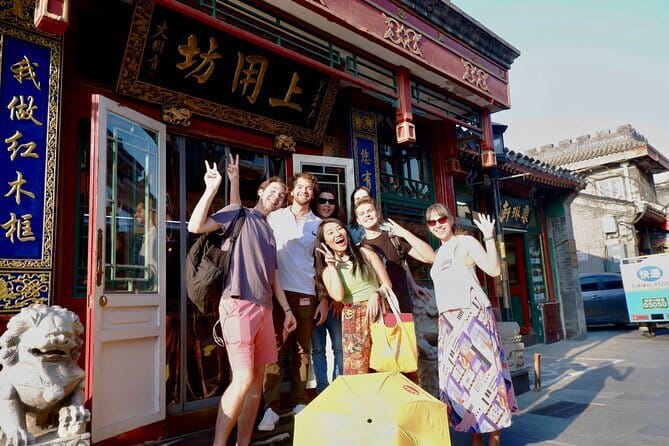
The hutong section lasts about an hour, making it the longest stop on the route. For me, this is the part that most clearly separates the walk from a standard sightseeing circuit.
Hutongs are narrow lanes lined with traditional residential compounds. The value here is not just seeing old walls or doorways. Your guide can explain how people lived in these neighborhoods, how the lanes fit into Beijing’s city plan, and how older residential areas face pressure as the capital grows and changes.
One review noted that the walk did not cover the big sites expected by the person booking it, but that the hutong visit became a worthwhile lesson instead. That is a useful warning. If you want a direct tour of Tiananmen Square, the Forbidden City, or other major imperial monuments, this is not that tour. If you want to understand how Beijing’s everyday neighborhoods fit into the larger city, the hutongs offer something those grand sights cannot.
The pace also matters. Reviews describe the rhythm as comfortable, with enough variety to keep the walk moving. You may pause for stories, look at local details, and continue without spending the entire morning in one formal site.
Wear comfortable shoes. The route lasts three and a half hours, and the hutong portion alone takes an hour. The tour is on foot, so your enjoyment will depend more on your comfort with walking than on any single landmark.
Liulichang Street, where Beijing’s arts tradition comes forward
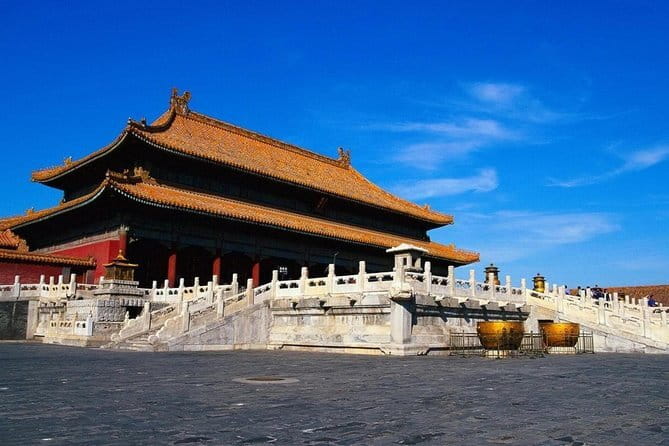
The walk continues to Liulichang Street for about 40 minutes. This historic quarter is associated with antiques, calligraphy, traditional painting, and other forms of Chinese art.
The description of the experience includes calligraphy creation, so this is the section to watch for that cultural element. The supplied details do not spell out exactly how long the calligraphy activity lasts or what form it takes, so I would treat it as part of the cultural experience rather than assume a long formal lesson.
Liulichang is valuable because it gives you a way to connect Chinese writing with the shops and working traditions around you. You might find displays of calligraphy, painting materials, or objects linked to older forms of collecting. A guide can help you understand what you are seeing instead of leaving you to decode every shop window alone.
This is also a place where expectations matter. The experience does not promise an included purchase, and the tour is not an antique-buying excursion. Think of the stop as a guided introduction to a historic arts street. If you see something you like, ask questions first and keep your wallet in your pocket until you are sure what you are buying.
More Walking Tours in Beijing
- Beijing Hutong Walking Food and Beer Tour at Hidden Restaurants
★ 5.0 · 1,132 reviews - Private Beijing Walking Tour of the Forbidden City with 7 Options
★ 5.0 · 675 reviews - Forbidden City Private Walking Tour with Optional Sights
★ 5.0 · 400 reviews - Beijing Private Hutong Food Walking Tour
★ 5.0 · 299 reviews
Yangmeizhu Byway brings in the newer Beijing
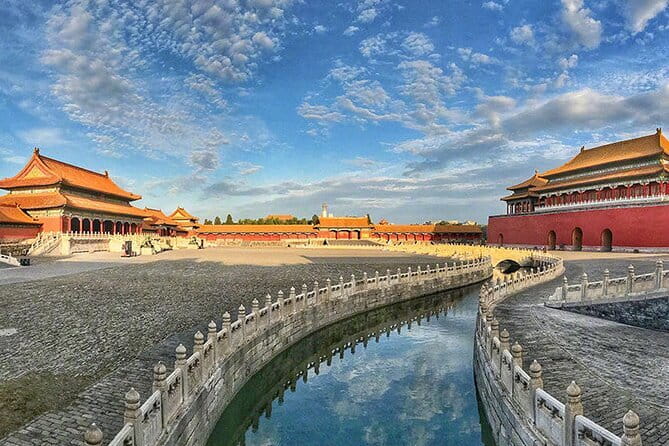
After Liulichang, the route shifts to Yangmeizhu Byway for about 20 minutes. The alley is presented as a place where old surroundings meet newer creative businesses, including boutique shops, art studios, and cafes.
This short stop helps explain why Beijing cannot be reduced to imperial buildings and preserved lanes. The city is also making room for new design, food, and small businesses in older districts. That contrast can be more revealing than another monumental gate.
You should not expect a long cafe break here. Twenty minutes is enough for an explanation and a look around, but not a leisurely shopping session. The appeal is the change of mood. After the residential hutongs and traditional art quarter, Yangmeizhu gives the walk a more current feel.
It is also a good point to listen for the guide’s comments about city planning. The tour promises discussion of Beijing’s planning progress and challenges, and this type of street makes those issues easier to picture. Old buildings, new businesses, tourism, and local life do not always fit together neatly.
Dashilan Street and the taste of old commerce
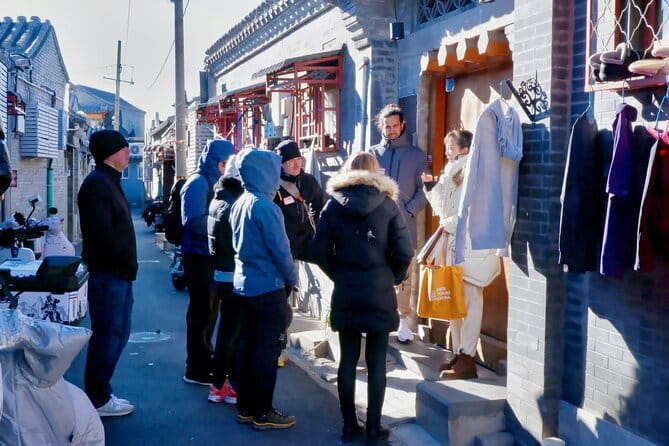
Dashilan Street receives about 20 minutes. It is described as Beijing’s oldest and most active commercial hub, with long-established shops, newer boutiques, and local food.
This is a short but useful stop for understanding how shopping streets helped shape the capital. The street is more social and commercial than the hutongs. You will likely have more visual noise, more people moving around, and more temptation to stop for a snack.
Food is one of the appealing extras of this walk. One account praised a street food sample, but tasting is not listed as a guaranteed inclusion, so you should not book solely for a promised meal. If your guide offers a sample, treat it as a pleasant addition. You may also get pointers on what to try after the tour.
The 20-minute limit keeps Dashilan from taking over the day. That is helpful if you want variety, but it also means you will not have much free time for serious shopping. I would save a note of any store or food stall that interests you and return later.
Qianmen Walking Street and the final view toward Tiananmen
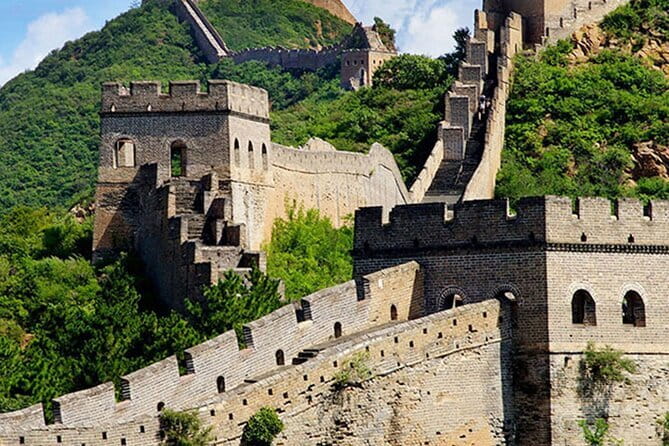
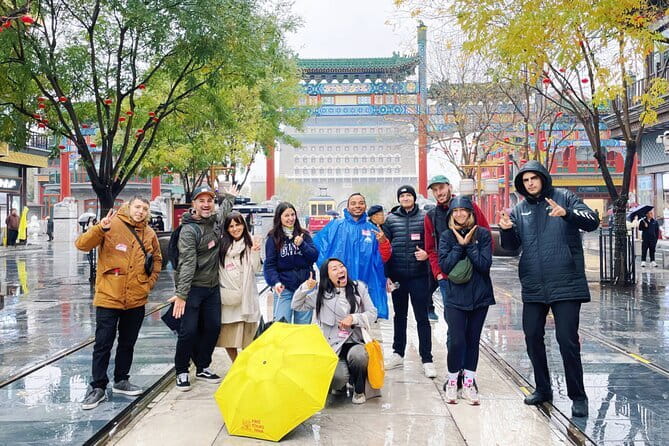
The final scheduled stop is Qianmen Walking Street, also for about 20 minutes. The area sits south of Tiananmen Square and combines restored historic architecture, shops, restaurants, and heavy pedestrian traffic.
Qianmen is a practical ending because it gives you choices. You can continue exploring the commercial streets, find food, use the metro, or make your way toward other central sights. The end point is Zhengyangmen, near Qianmen Metro Station on Lines 2 and 8.
The key limitation is simple: the tour ends in front of Tiananmen Square, but does not enter it. You need to make your own reservation at least one day ahead if you want to visit the square. Same-day reservations are not available, so plan this before the walking tour rather than hoping to add it afterward.
This final section can feel more crowded and commercial than the hutongs. That is not a flaw, but it changes the mood. The route finishes with public activity and shopping instead of a quiet historical site.
What the $5 price really means
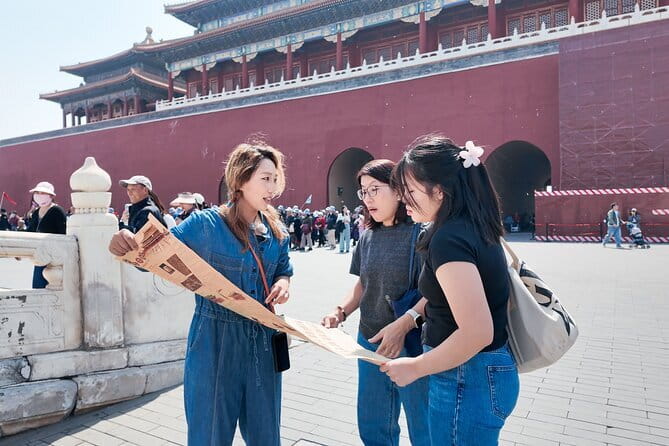
The advertised $5 per-person charge is unusually low because it is a booking fee, not the full payment for the guide’s work. The tour uses a tips-based model, and you choose the amount to give at the end.
The suggested tip is 160 to 200 RMB, described as about $20 to $25. Add that to the booking fee when judging the cost. The total is still modest for three and a half hours with an English-speaking local guide, but you should understand the arrangement before reserving.
I like the flexibility of this model. You can judge the guide based on the actual experience, and a good guide can earn recognition for careful explanations, patience, and organization. The downside is that the final cost is not fixed. If you prefer to know the exact price in advance, a standard paid tour may feel simpler.
The guide is the main product here. You are not paying for costly entrance tickets, transportation, or a large formal attraction. You are paying for interpretation, local context, and a route that would be harder to understand on your own.
Group size, timing, and practical planning
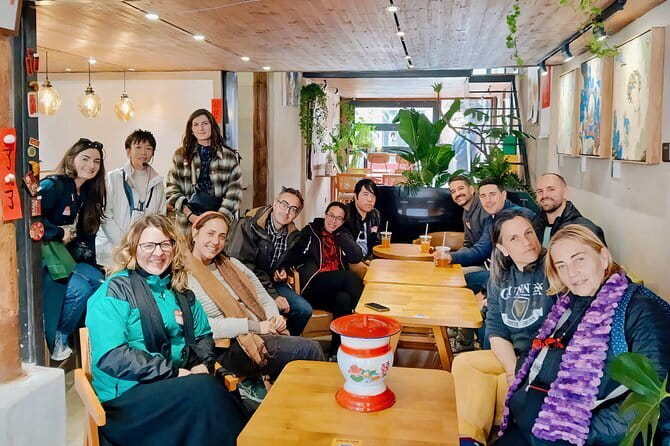
The experience is described as a shared group walk, limited to six people per booking. It also lists a maximum of 50 participants for the activity, which creates some uncertainty about the total group size. One account described the group as huge, so I would confirm the expected group size before booking if a small gathering is important to you.
If your own party has more than six people, contact the provider about a private tour. Do not assume one booking will cover a larger party under the shared-tour arrangement.
The tour begins at 10:00 a.m. at Huguang Guild Hall and ends at Zhengyangmen near Qianmen Metro Station. That makes public transport useful at both ends, and the finish is convenient for continuing around central Beijing.
Confirmation is provided at booking, and mobile tickets are supported. Most people can take part, but remember that this is a walking experience with a one-hour hutong section and several connecting stretches between stops.
The tour requires good weather. If poor weather cancels it, you are offered another date or a full refund. You can cancel up to 24 hours before the start for a full refund, while later cancellations and changes are not accepted.
Who will get the most from this Beijing walk
I would choose this tour if you want a first look at Beijing that goes beyond the famous imperial attractions. It suits you especially well if you enjoy local stories, old residential lanes, traditional arts, street food, and the way historic districts change over time.
It also works well when your schedule is tight. The route gives you several different parts of central Beijing in one morning, and the finish near Qianmen makes it easy to continue exploring.
You may want something else if your priority is entering Tiananmen Square or seeing a major palace. Those are not part of the walk. You should also be comfortable with the tips model and with the possibility of a larger shared group.
For food lovers, the tour offers useful direction but not a guaranteed tasting program. For photographers, the hutongs, guild hall, old shop streets, and Qianmen area provide variety, though the schedule may not allow long stops for carefully arranged pictures.
Should you book the Beijing Historic City Walking Tour?
Book it if you want stories and street-level context, not just famous façades. The strongest parts are the hutong hour, the shift from Liulichang’s calligraphy culture to Yangmeizhu’s newer businesses, and the final move through Dashilan and Qianmen.
Before you reserve, accept three conditions: Tiananmen Square is not included, the $5 fee is followed by a suggested tip, and the group size may need clarification. If those points suit you, the walk offers good value and a thoughtful introduction to Beijing’s older neighborhoods, working streets, and changing city life.
FAQ
How long does the Beijing Historic City Guided Walking Tour last?
The tour lasts approximately 3 hours and 30 minutes.
Where does the tour begin?
It begins at Huguang Guild Hall, 3 Hu Fang Lu, Xicheng District, Beijing.
What time does the walking tour start?
The start time is 10:00 a.m.
Where does the tour end?
It ends at Zhengyangmen near Qianmen Metro Station, served by Lines 2 and 8.
Does the tour enter Tiananmen Square?
No. The tour ends in front of Tiananmen Square but does not enter it. You must make your own reservation at least one day in advance if you want to visit, since same-day reservations are not possible.
Is the $5 booking fee the full tour price?
No. The $5 fee reserves your place. The tour uses a tips-based model, with a suggested tip of 160 to 200 RMB, approximately $20 to $25.
Can I cancel for a full refund?
Yes, if you cancel at least 24 hours before the experience starts. Cancellations or changes made less than 24 hours before the start are not accepted, and poor-weather cancellations offer another date or a full refund.
More Calligraphy Workshops in Beijing
- Beijing Calligraphy Class
★ 4.9 · 112 reviews - Chinese Calligraphy Class for Small Group
★ 5.0 · 104 reviews - Beijing Wangfujing Calligraphy Class by Forbidden City
★ 5.0 · 58 reviews - Beijing Wangfujing Calligraphy Class Nearby Forbidden City
★ 5.0 · 56 reviews
Just added in Beijing
- Private Transfer to Mutianyu Great Wall with professional driver★ 5.0 · 19 reviews
- One day tour to downtown Tianjin from Beijing by high speed train★ 5.0 · 3 reviews
- ZANBUS: Trip to the Jinshanling Great Wall Departing at 7:30 AM★ 5.0 · 5 reviews
- camp on the Great Wall overnight with sunrise and sunset on the wall★ 5.0 · 11 reviews
- Yuxiandu Chinese Royal Cuisine Museum with Show and Royal Banquet★ 5.0 · 4 reviews
- Wild Great Wall Hikes★ 5.0 · 10 reviews
- BusDa:Ancient Great Wall &Badaling Great Wall Full-day Bus Tour★ 4.5 · 6 reviews
- Wild Great Wall Huanghuacheng Half Day Tour★ 5.0 · 15 reviews
Calligraphy Workshops, compared.
Beijing Wangfujing Calligraphy Class by Forbidden City
Read our review →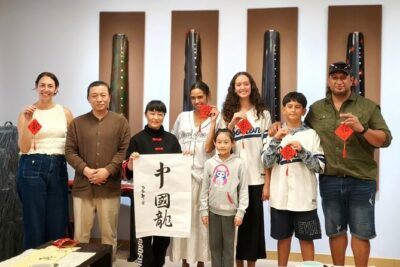
Beijing Culture: Tea Ceremony, Heritage Instrument & Calligraphy
Read our review →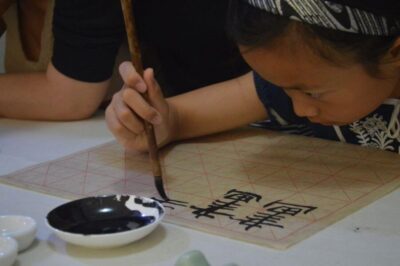
Beijing Wangfujing Calligraphy Class Nearby Forbidden City
Read our review →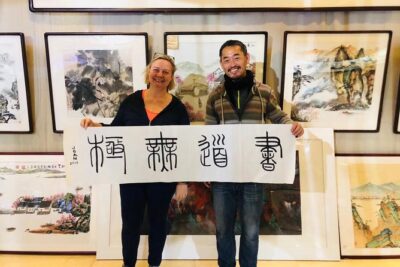
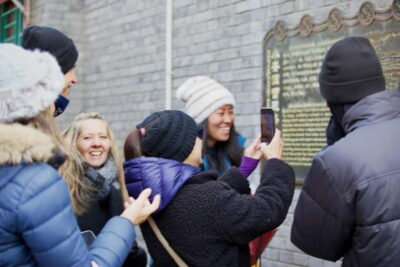
Discover Old Beijing: Hutong Walking Tour & Calligraphy
Read our review →
Zhujiajiao Water Town with Calligraphy Experience
Read our review →Where else this tour turns up