
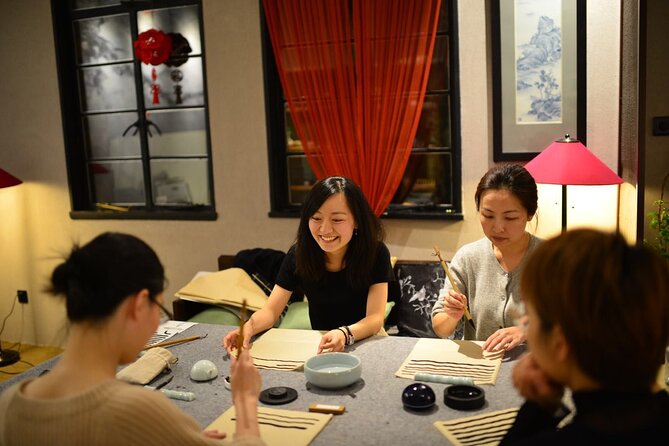
Reviewed · CALLIGRAPHY WORKSHOPS
2-Hour Chinese Calligraphy with an Artist in Shanghai, China
Brush, ink, and a quiet room can change your Shanghai day. This two-hour workshop with artist Lucy gives you a friendly introduction to Chinese calligraphy, from the meaning of different scripts to the feel of brush on paper. I especially like the short cultural lesson before the hands-on work, and the chance to take home a folding fan or scroll with your own character on it. The main drawback is the studio’s location inside a residential lane, which can take a little patience to find.
The class costs $50 per person, a fair price when you consider that tools, materials, tea or coffee, instruction, and your finished artwork are included. It is a small-group experience capped at eight people, so you should receive more help than you would in a large tourist workshop. Still, this is an introduction, not a route to polished calligraphy in two hours. Your first strokes may look more like enthusiastic experiments than museum pieces.
In This Review
- Key points before you book
- Why calligraphy makes a good Shanghai activity
- Arriving at the Yugucun studio near Jing’an
- The opening lesson: scripts, stories, and Chinese ideas about art
- The tools: brush, ink, paper, and posture
- Practice time: where the class becomes useful
- Making your folding fan or scroll
- How Lucy shapes the experience
- What $50 includes, and where the value lies
- Morning, afternoon, or evening: choosing your slot
- Who should book this class?
- Practical details worth knowing
- Should you book the Shanghai calligraphy workshop?
- FAQ
- How long does the Chinese calligraphy class last?
- Where does the class begin and end?
- What is included in the $50 price?
- Do I need previous calligraphy experience?
- What will I make during the workshop?
- How many people can join the class?
- Can I cancel for a full refund?
Key points before you book
- You learn from artist Lucy: Her calm, patient teaching style is one of the strongest parts of the experience.
- You start with context: A short lesson covers Chinese scripts, famous works, and the way calligraphy is viewed in Chinese culture.
- You practice before the final piece: Basic brush handling and strokes come first, so you are not sent straight to the fan with a wet brush and high hopes.
- You create a personal souvenir: Choose a Chinese character and write it on a traditional folding fan, with scroll work also possible in some sessions.
- The group is limited to eight: That gives you a better chance to ask questions and receive corrections.
- The meeting point needs attention: Yugucun is near Jing’an and public transport, but the lane entrance can be easy to miss without the directions provided.
Why calligraphy makes a good Shanghai activity
Shanghai can fill a day with grand buildings, shopping streets, museums, and plenty of food. Those are worthwhile, but this class gives you something quieter and more personal. Instead of only looking at Chinese art, you use the same basic tools that have shaped written Chinese culture for centuries.
Calligraphy is not simply handwriting with decoration added. The pressure of the brush, the angle of the tip, the speed of each movement, and the empty space around a character all matter. Even a beginner can feel this within minutes. Ink moves quickly, and a stroke cannot be erased in the usual way. That makes the class both relaxing and mildly nerve-racking, which is a useful combination for a holiday activity.
I also like the way the workshop connects art with daily life. You may notice Chinese characters on signs, shop fronts, temple plaques, and museum objects after the class. You will not suddenly be able to read everything, but you may begin to notice the shape and balance of the writing instead of seeing it as a blur of unfamiliar symbols.
More calligraphy workshops in Shanghai:
Arriving at the Yugucun studio near Jing’an
The class begins at Yugucun’s north gate, at 361 Lane 3, Yuyuan Road, in Jing’an District. The experience ends at the same meeting point. The address places you in a central part of Shanghai, near public transportation and the Jing’an area, so it can fit neatly between other city plans.
The practical warning is simple: allow extra time to locate the entrance. The studio is in a lane rather than on a broad, obvious commercial street. Once inside the lane, house numbers are reported to be well marked, but getting from the metro area to the correct lane may require careful use of the directions sent by Lucy.
I would save the meeting details before leaving your hotel and keep your phone ready for messages. Lucy has helped with directions and has communicated through WeChat, which is useful if you are uncertain about the final approach. This is not a reason to avoid the class, but it is a reason not to arrive at the last possible minute.
The space itself is described as welcoming, calm, and spacious. Tea or coffee is included, and some sessions have a quiet studio mood with music in the background. That makes the workshop a pleasant pause from Shanghai’s traffic and crowds.
The opening lesson: scripts, stories, and Chinese ideas about art
The first section is a brief introduction to Chinese calligraphy. You learn about the development of Chinese scripts and see examples of admired works. The talk is not meant to be a university lecture. It gives you just enough background to understand why the writing styles look different and why calligraphy holds such an important place in Chinese art.
Lucy explains that Chinese calligraphy is viewed as more than a practical writing system. The movement of the brush reveals the writer’s control, rhythm, and character. That idea helps explain why a simple-looking stroke can receive so much attention.
You may also hear stories connected with famous calligraphic works and see facsimiles of respected scrolls. This is a valuable part of the class because it gives your practice a cultural frame. Without it, the lesson could become a craft activity. With it, you begin to understand why a character on a wall, fan, or hanging scroll can carry artistic weight.
The class can also introduce several writing styles, including seal script and regular script. You do not need to know the names in advance. Lucy explains the visual differences and can adapt the final project to your interests. One person with prior interest chose regular script rather than seal script, showing that the lesson is not locked into one rigid format.
The tools: brush, ink, paper, and posture
Next, you handle the traditional tools. Materials and instruction are included, so you can arrive without buying a brush or carrying special paper across China. This is a real advantage for a short holiday activity.
Lucy introduces the tools and shows how to hold the brush. Beginners often grip it like a pencil, but Chinese calligraphy uses a different approach. Your hand, wrist, and arm need to stay controlled while allowing the brush to move freely. The correct position may feel awkward at first, especially if you are used to writing with a ballpoint pen.
You learn how the brush responds to pressure. A heavier touch can create a broad mark, while a lighter movement produces a thinner line. Speed matters too. The ink flows fast, and hesitation can leave an uneven stroke. That is why the early practice period is important.
This hands-on explanation is one reason the class works better than simply copying a character from a book. Lucy can watch your movement and suggest a small correction. She is described as patient and encouraging, which matters when your first attempts look less elegant than the examples in front of you.
A few more to weigh up in Shanghai
- Authentic Local Food Tour in Central Shanghai
★ 5.0 · 1,382 reviews - Zhujiajiao Water Town and Shanghai City Private Day Tour
★ 5.0 · 1,016 reviews - Private Shanghai Full Day City Tour with Old and New Highlights
★ 5.0 · 995 reviews - Shanghai: Hop-on Hop-off Bus Ticket and Optional Attractions
★ 3.4 · 692 reviews
Practice time: where the class becomes useful
The warm-up section gives you time to repeat basic strokes before starting the final artwork. You may practice lines, turns, dots, and other building blocks of Chinese characters. This is not busywork. It lets you learn how much ink the brush carries and how quickly the paper absorbs it.
I would approach this stage with modest expectations. Calligraphy is harder than it looks. A character can appear simple, yet a small change in pressure or direction can alter its balance. The class gives you a feel for the technique, but it cannot replace regular practice.
The good news is that the atmosphere appears supportive rather than strict. Lucy guides individual participants and adjusts her teaching to the group’s ability. Families can take part too. The class has worked for children aged five, nine, and twelve, as well as adult beginners. Younger children may need help with brush control, but the creative result gives them a clear goal.
If you have already practiced Chinese calligraphy, you can ask more specific questions about scripts and technique. If you are starting from zero, you can stay with the basic movements. The small group, with no more than eight participants, makes this flexibility possible.
Making your folding fan or scroll
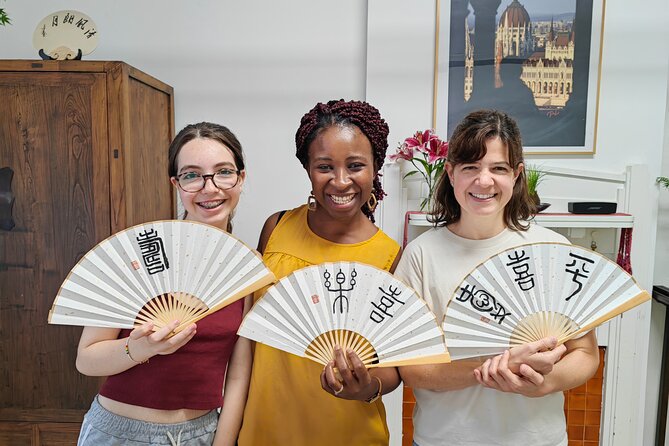
The final stage turns practice into a souvenir. You choose a favorite Chinese character and write it on a traditional folding fan. Some sessions also include a scroll or script roll, so the precise final format may depend on the class and your preferences.
The fan is a smart choice for a Shanghai keepsake. It is light, useful in warm weather, and connected to traditional Chinese art. More important, it carries your own brushwork rather than a printed design from a souvenir shop. You may not produce a perfect character, but you will remember the process each time you see it.
Lucy demonstrates the selected character and helps you refine your technique. She can guide you through the order and shape of the strokes, then offer corrections while you work. That support makes the final piece feel achievable without pretending that two hours makes you a calligrapher.
You should expect some variation in the finished work. Ink can spread, a line can run too long, or the spacing can feel off. That is part of the appeal. The final fan records your first attempt, and the small imperfections make it yours.
One useful tip is to think about your chosen character before class if you can. You can still decide during the workshop, but a character connected to your name, a personal value, or a favorite idea will make the finished fan more meaningful. The available information confirms that you select a favorite character, but it does not promise translation help for every possible choice, so ask Lucy if you are unsure about a word.
How Lucy shapes the experience
The strongest feature here is Lucy’s teaching. She is described as kind, attentive, flexible, and clear in English. Those qualities matter more than a fancy studio or a long lecture. Calligraphy requires close observation, and a good instructor can make the difference between frustration and progress.
Lucy’s approach appears to suit mixed groups. She can explain the cultural side for someone curious about Chinese art, then shift to close brush guidance for someone who wants to improve a specific stroke. She also answers questions in a straightforward way, which is useful if you want more than a quick tourist demonstration.
Some sessions have lasted longer than the advertised two hours when the discussion or artwork needed extra time. You should not count on an extended class when planning your day, but it suggests that the workshop is not run with a stopwatch in hand.
The class has received a 5.0 rating from 46 reviews, with 100 percent recommending it. Those figures point to unusually consistent satisfaction, especially around Lucy’s patience, the clear instruction, and the personal artwork. They do not mean every brushstroke will look good. They do suggest that the teaching and overall setting deliver what a beginner needs.
What $50 includes, and where the value lies
At $50 per person, this is not the cheapest way to spend two hours in Shanghai. You could visit a public park or browse a market for less. The comparison is not quite fair, though, because this price includes a teacher, a small group, all calligraphy tools, paper and other materials, tea or coffee, and a finished piece to take home.
I see the best value in the personal instruction. A ready-made fan costs less than $50, but it will not teach you how brush pressure shapes a stroke or explain the role of different scripts. The experience also gives you a new way to look at calligraphy during the rest of your visit.
For families and couples, the price covers an activity you can share without needing prior knowledge. For solo visitors, the small class offers a social setting without the scale of a busy group tour. For anyone already interested in painting or Chinese art, the workshop may be a starting point for more lessons.
The price is less appealing if you want a formal qualification, advanced technique, or a large number of finished pieces. This is a compact introduction with one main artwork. Think of it as a cultural lesson with a hands-on result, not a full course.
Morning, afternoon, or evening: choosing your slot
You can choose from morning, afternoon, or evening sessions. That flexibility makes the workshop easy to place into a Shanghai itinerary.
A morning class can work well before a day of sightseeing, especially if you want to begin with a calm activity. An afternoon class gives you a break after museums, shopping, or walking around Jing’an. An evening session can be useful when you want something more focused than another meal or shopping stop.
Remember to protect enough time for the journey to Yugucun. The class itself lasts about two hours, and finding the lane may take longer than expected. I would avoid scheduling a major attraction immediately afterward if you are unfamiliar with the area.
Who should book this class?
This workshop is a strong match for:
- First-time visitors who want a cultural activity beyond sightseeing
- Families with children who can follow basic instruction
- Solo visitors looking for a quiet, social experience
- People interested in Chinese art, writing, painting, or design
- Anyone who wants a lightweight, personal souvenir
- Visitors staying near Jing’an who can reach the meeting point easily
You do not need artistic experience. In fact, complete beginners may get the most from Lucy’s step-by-step approach.
I would think twice if you dislike seated craft activities, want a fast-paced tour, or expect to produce professional calligraphy immediately. The class asks for patience and concentration. Your reward is not instant mastery. It is a better understanding of the art and a handmade object connected to your time in Shanghai.
Practical details worth knowing
Confirmation is provided at booking, and the experience uses a mobile ticket. Service animals are allowed, and most people can participate. The maximum group size is eight.
Free cancellation is available when you cancel at least 24 hours before the start time. Changes or cancellations inside that window are not accepted for a refund. The activity also requires a minimum number of participants. If that minimum is not reached and the class is canceled, you can receive a full refund or choose another date or experience.
Bring your booking details, arrive with extra time, and follow Lucy’s directions carefully from public transport. You do not need to bring brushes, ink, paper, or other supplies.
Should you book the Shanghai calligraphy workshop?
I would book this experience if you want to slow down for two hours and learn by doing. The cultural introduction gives the activity meaning, Lucy provides patient guidance, and the fan or scroll gives you something personal to carry home.
The strongest reason to go is not the promise of perfect calligraphy. It is the chance to understand a traditional art form through your own hand. At $50, the workshop offers solid value for a small group, included materials, refreshments, instruction, and a keepsake.
Skip it if your schedule is packed, you dislike creative activities, or you need a studio that is effortless to find from the street. For most visitors, though, the lane is a minor nuisance. Once you sit down with the brush, the city’s noise feels pleasantly far away.
FAQ
How long does the Chinese calligraphy class last?
The workshop lasts approximately two hours.
Where does the class begin and end?
It begins at the north gate of Yugucun, at 361 Lane 3, Yuyuan Road, Jing’an District, Shanghai. The activity ends back at the meeting point.
What is included in the $50 price?
The price includes instruction, calligraphy tools, materials, and tea or coffee. You also create a piece of artwork to take home.
Do I need previous calligraphy experience?
No. The class introduces the basic tools and writing techniques, then gives you time to practice before creating the final artwork.
What will I make during the workshop?
You create artwork on a traditional folding fan using a Chinese character you choose. Some class sessions also include a scroll or script roll.
How many people can join the class?
The activity has a maximum of eight participants.
Can I cancel for a full refund?
Yes, if you cancel at least 24 hours before the experience start time. Cancellations or changes made less than 24 hours before the start time are not refunded or accepted.
Just added in Shanghai
- Zhujiajiao Water Village: Private Tour from Shanghai★ 4.9 · 43 reviews
- Zhujiajiao with Private Customized Shanghai City Highlights★ 5.0 · 14 reviews
- Zhujiajiao Water Town Private Tour with Night River Cruise★ 5.0 · 9 reviews
- Zhujiajiao & Shanghai:Small Group Tour Water Town to Skyline★ 5.0 · 4 reviews
- Zhujiajiao & Shanghai:Private Day Tour Water Town to Skyline★ 5.0 · 12 reviews
- Yu Garden Shanghai Entry Tickets Booking And Trip★ 3.6 · 9 reviews
- Water Town Zhujiajiao Shanghai: Boat Ride,Sights,Bites&Sips★ 5.0 · 7 reviews
- shanghai Disney tour★ 5.0 · 12 reviews
Calligraphy Workshops, compared.
Beijing Historic City Guided Walking Tour + Calligraphy Creation
Read our review →
Beijing Wangfujing Calligraphy Class by Forbidden City
Read our review →
Beijing Culture: Tea Ceremony, Heritage Instrument & Calligraphy
Read our review →
Beijing Wangfujing Calligraphy Class Nearby Forbidden City
Read our review →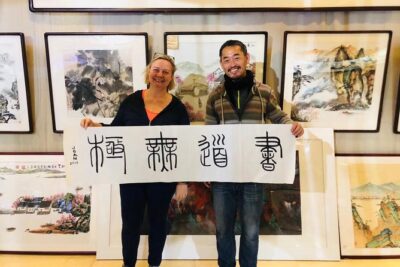
Discover Old Beijing: Hutong Walking Tour & Calligraphy
Read our review →Where else this tour turns up