
Reviewed · EVENING EXPERIENCES
2-Hour “Ancient & Modern” Beijing Sidecar Tour (Day /Night)
Beijing reveals itself from the sidecar. This two-hour ride links the quiet hutongs, old city landmarks, lakes, and sleek CBD in one compact outing. I like the close-up view of daily life in the alleys, and I like the way the route pairs the Bell and Drum Towers with the CCTV building and Workers’ Stadium. The main consideration is that two hours moves quickly, so you will see many places from the road rather than spend long periods inside them.
This is a private tour for your own group, with a professional driver-guide, helmets, bottled water, rain protection, phone charging cable, local snacks, and seasonal drinks. John is named in the available feedback, and his punctual hotel pickup and flexible drop-off earned special praise. Still, confirm your pickup arrangement, since the stated meeting point is outside the National Art Museum of China.
The ride costs $89 per person. That is not the cheapest way to move around Beijing, but it buys a small-group experience, a guide, transport between scattered sights, and a memorable way to see the city. I would use it early in a Beijing stay, when a fast orientation helps you understand how the old center and new business district fit together.
In This Review
- Key details before you book
- Why a sidecar works so well in Beijing
- Hutongs: the most local part of the route
- Bell and Drum Towers: Beijing’s central axis
- Shichahai and Houhai: a slower pause by the water
- The Forbidden City moat from the north
- Workers’ Stadium and Beijing’s newer public face
- CCTV New Mansion and the CBD skyline
- Ming City Wall Park: where old and new meet
- Day or night, and what two hours really means
- Is $89 per person good value?
- Who should book this Beijing ride?
- Should you book the Ancient and Modern sidecar tour?
- FAQ
- How long does the Beijing sidecar tour last?
- Where does the tour start?
- Where does the tour finish?
- How many people ride in one sidecar?
- Are drinks and food included?
- Does the tour operate in bad weather?
- Can I cancel for a full refund?
Key details before you book
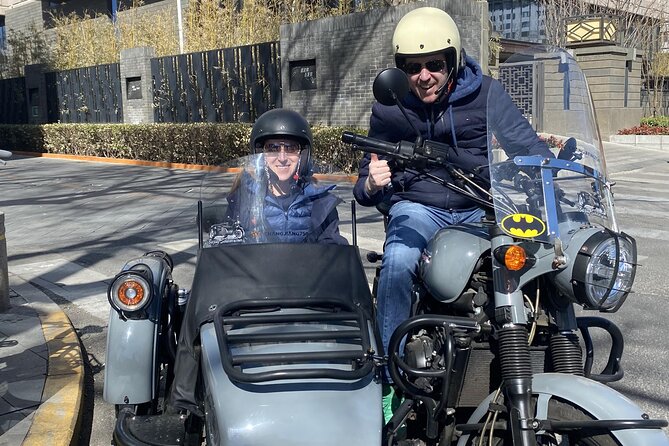
- Two passengers share one sidecar: One person rides in the sidecar and one sits behind the driver, with a switch halfway through if you wish.
- The route crosses old and new Beijing: You pass hutongs, the Bell and Drum Towers, Houhai, the Forbidden City moat, Workers’ Stadium, the CCTV New Mansion, and the Ming City Wall Park.
- Photo stops are built in: Short pauses at several locations give you time to take pictures and enjoy a drink without turning the outing into a long walking tour.
- Pickup may be available: The formal start is at the National Art Museum of China, while a past booking included hotel pickup and a flexible final drop-off. Confirm the details before setting out.
- Weather affects the ride: The activity requires good weather. If poor weather cancels it, you can choose another date or receive a full refund.
- Day and night options are offered: The route can suit different moods, from clearer daytime views to evening city lights, though the exact availability should be checked when booking.
Why a sidecar works so well in Beijing
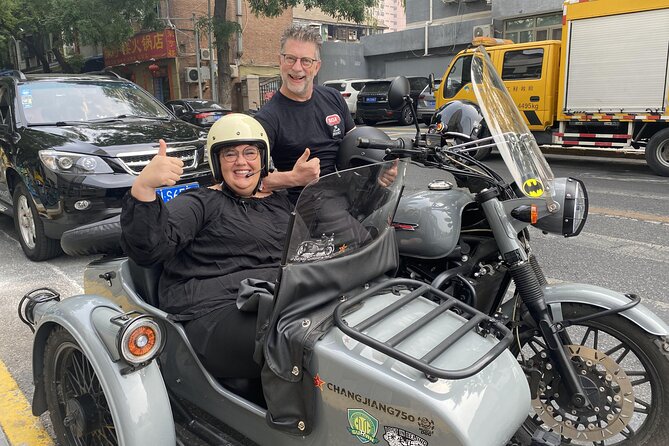
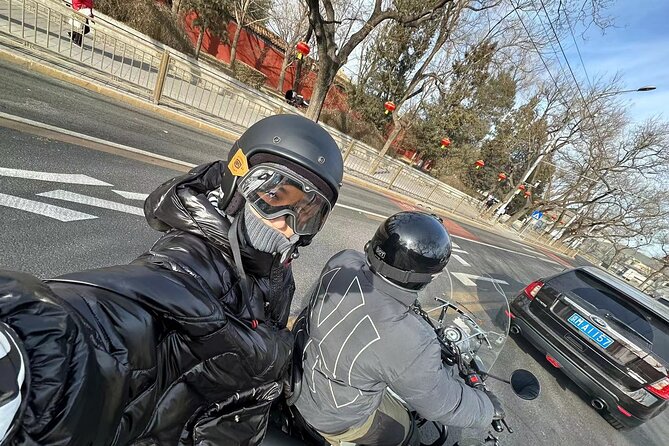
Beijing is too spread out for a short walking tour to cover both its old core and its newer districts. A regular vehicle can handle the distance, but it puts glass between you and the city. A sidecar gives you open-air views, street sounds, and a closer look at the hutongs as you move from one part of town to another.
The format also keeps the group small. This is a private activity, so your own party participates rather than joining a large coach. That matters in narrow lanes, where a big vehicle would feel clumsy and miss the point of the ride.
You should also understand the seating arrangement. One passenger sits in the sidecar, while the other rides behind the driver. The two passengers can switch halfway through, which is important because the positions offer different views and different levels of wind. If you are booking for two people, agree in advance who wants which seat first.
The tour includes helmets, a raincoat, bottled water, a phone charging cable, and a professional driver-guide. Snacks and drinks are part of the experience too: hot coffee or tea in winter, and cold soda or beer in summer. These touches make the ride feel less like a simple transfer and more like a short city outing.
A few more to weigh up in Beijing
- From Beijing: Mutianyu Great Wall Tours with Options
★ 4.9 · 9,216 reviews - Beijing: Forbidden City Tour(Group/Private)-Tickets Included
★ 4.8 · 7,974 reviews - Beijing: T-Square & Forbidden City Group or Private Tour
★ 4.8 · 4,446 reviews
Hutongs: the most local part of the route
The hutongs are likely to be the most atmospheric part of your ride. These traditional small lanes show a side of Beijing that can be hard to grasp from major monuments alone. You pass close to ordinary city life, with the road itself providing the view rather than a formal exhibit or grand entrance.
I like this part because it gives the old city a human scale. Beijing’s headline sights can feel immense and ceremonial. The hutongs bring you down to doors, lanes, and neighborhood rhythms.
The trade-off is that a moving view is not the same as a detailed walking visit. You may see an authentic lane and take photographs, but you should not expect a long stop at every corner. If you want a slow, detailed look at hutong architecture, daily routines, or local homes, you will need extra time elsewhere in your schedule.
Still, the sidecar is a good match for these alleys. It is small enough for the setting and lets you look to both sides as you ride. Keep your camera ready, but do not spend the whole time looking at a screen. The value here is seeing how the old lanes connect to the wider city.
Bell and Drum Towers: Beijing’s central axis
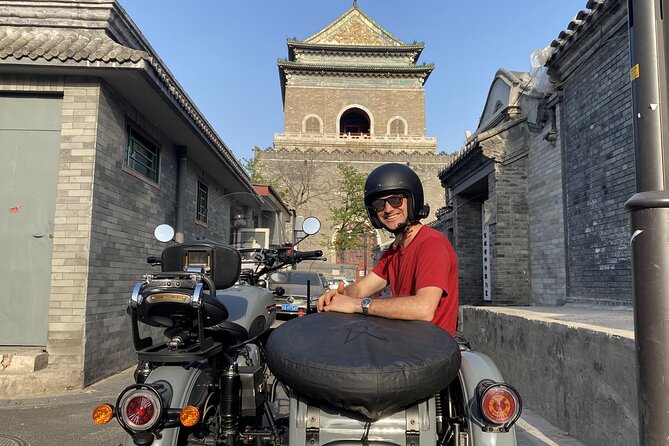
The Bell and Drum Towers are two of the key landmarks on Beijing’s central axis. You get about five minutes here, with no admission charge included because there is no ticket cost for this stop.
Five minutes is enough for a quick photograph and a look at the buildings’ role in the old city layout. It is not enough for a full visit inside, so treat this as an orientation stop rather than a museum visit.
The towers are also popular photo locations, making them useful early landmarks on the route. Your guide can place them in context as part of the historic center before the ride continues toward Shichahai.
If you enjoy architecture and city planning, pay attention to the straight north-south organization of central Beijing. The tour does not ask you to spend an hour on a single monument. Instead, it gives you a quick visual link between several parts of the city.
Shichahai and Houhai: a slower pause by the water
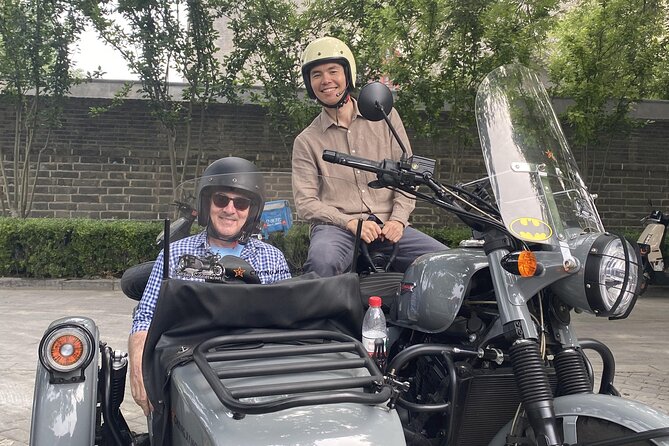
The ride along Houhai lakes gives the tour one of its gentler moments. You have about 15 minutes to enjoy the view and stop for drinks. After the noise and movement of the lanes, time beside the water provides a useful change of pace.
This is one of the better places to pause rather than simply photograph from the seat. You can have a cold soda or beer in summer, or enjoy hot coffee or tea in winter. Bottled water is also supplied.
The stop is free, and you do not need to plan a separate ticket. That helps keep the two-hour route simple.
Keep your expectations in proportion. This is a scenic break, not a full Shichahai walking tour or a dedicated lake excursion. You will have time to look around and refresh yourself, but not time to explore every waterside lane. The short stop works best if you want variety and a chance to sit back between road sections.
A completely different sort of day out:
- All-Inclusive Tour: Tiananmen Square, Forbidden City, Great Wall
★ 5.0 · 2,873 reviews - MuBus: Mutianyu Great Wall ENG/ESP/RUS Guided Bus Tour
★ 5.0 · 2,361 reviews - 4-Hour Small Group Tour to Forbidden City with Entry Tickets
★ 5.0 · 1,863 reviews - Beijing: Tiananmen Square Registration Service(Ticket)
★ 4.5 · 1,704 reviews
The Forbidden City moat from the north
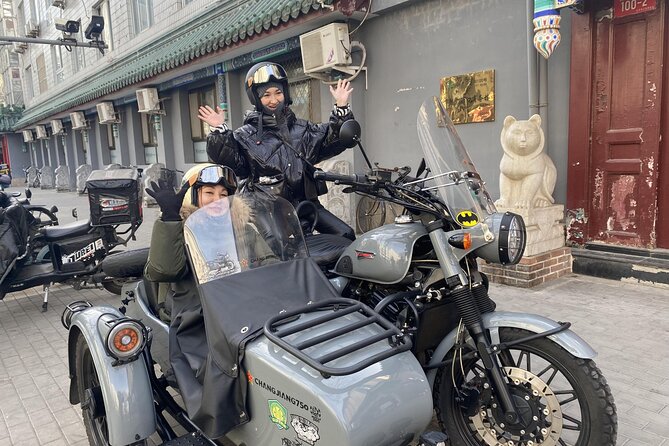
The route passes the north gate of the Forbidden City, along with the moat and its Watching Tower. This is a smart choice for a short city tour because it lets you see the outer edge of one of Beijing’s major historic sites without spending the hours required for an interior visit.
You should note that the Forbidden City is a pass-by section here, not a ticketed entry. The itinerary does not provide admission or time inside the palace grounds. If the Forbidden City is a major reason for your Beijing visit, reserve a separate visit and treat this glimpse as added context.
From the sidecar, the moat and tower help you understand the scale and defensive character of the old imperial center. The view also makes a clear bridge between the hutongs and the monumental heart of Beijing.
This part is especially useful if you are still learning the city’s layout. You get a sense of how the historic center sits within modern traffic and neighborhoods, rather than seeing it as an isolated attraction.
Workers’ Stadium and Beijing’s newer public face
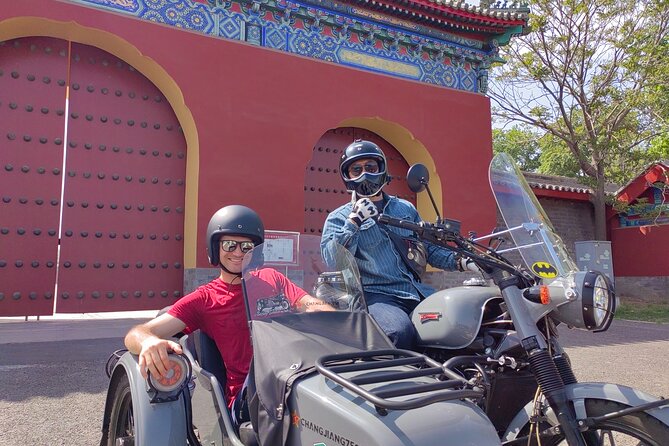
The Beijing Workers’ Stadium is a short five-minute stop. It is described as a famous city landmark and the brand-new stadium of Beijing’s football team.
This stop adds a modern public venue to a route otherwise weighted toward older Beijing. You can take a photograph, hear about the stadium, and see how the city uses large contemporary buildings alongside its older districts.
The limitation is clear: five minutes will not allow much more than a quick look. There is no match or event included, and the tour does not promise entry. Think of it as a city landmark stop, not a sports experience.
For many visitors, that is enough. A good orientation tour should show more than temples and palace walls. Seeing a current stadium gives you another clue about present-day Beijing and the interests of people who live there now.
CCTV New Mansion and the CBD skyline
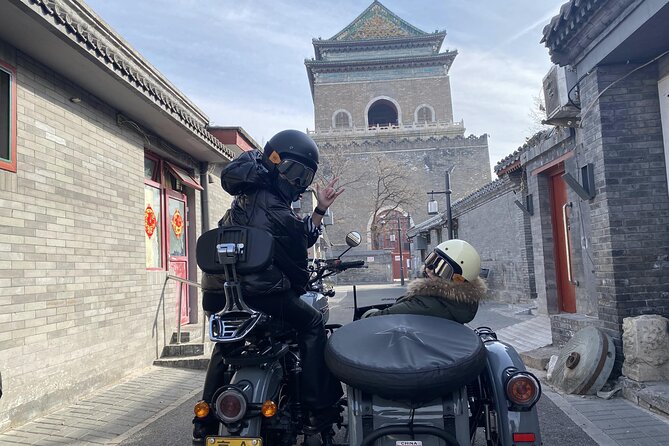
The ride then moves into Beijing’s Central Business District, where you see the CCTV New Mansion and the tallest building in Beijing. This is the sharpest visual change on the route.
The unusual CCTV building is one of the city’s best-known pieces of modern architecture. From an open sidecar, you can look up at its shape and compare it with the older streets you have just left. The five-minute stop is short, but the contrast is the point.
I like this section because it avoids presenting Beijing as an old capital frozen in time. The city has ancient lanes, imperial walls, major sports venues, and ambitious office towers. Putting them in one ride helps you see the city as a place that keeps changing.
Again, do not expect a tower visit or an extended architecture talk. You are seeing the CBD from street level, with a brief photo pause. At night, this portion may appeal to you if you enjoy illuminated buildings and city views. During the day, the shapes and scale may be easier to study.
Ming City Wall Park: where old and new meet
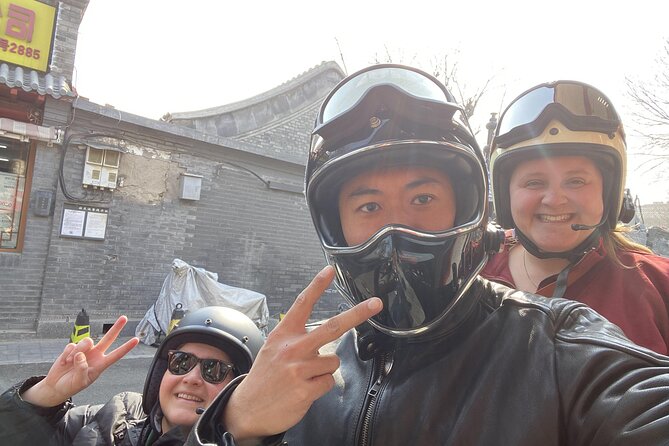
The final major stop is the Site of Ming City Wall Park, where about 15 minutes are provided. It contains the only existing section of Beijing’s original intercity wall, making it one of the most meaningful stops on a route built around contrast.
The park gives you more time than the five-minute landmark pauses. You can slow down, take photographs, have a snack or drink, and think about the shift from the old city’s walls to the modern roads and towers around them.
This is where the tour’s theme makes the most sense. The wall is not presented as a grand isolated ruin. It is part of a living city, surrounded by modern Beijing. That setting lets you see how older structures survive within a very current urban center.
Do not expect a full archaeological visit or a long walk along the wall. The stop is still only 15 minutes. But compared with the brief photo pauses, it gives you enough time to appreciate the location rather than simply point a camera at it.
Day or night, and what two hours really means
The experience is offered during the day or at night. A daytime ride may help you see hutong details, towers, wall sections, and modern buildings more clearly. An evening ride may make the CBD and city streets feel more dramatic, though the exact atmosphere depends on the date and conditions.
The route has several stops, but the total duration is only about two hours. That makes it a strong introduction, not a complete tour of each district. You will cover a lot of ground, yet you will not receive extended time at the Bell and Drum Towers, the Forbidden City, Workers’ Stadium, or CCTV New Mansion.
I would plan a separate full visit to any place that matters most to you. Use this ride to connect the dots, spot areas you may want to revisit, and get a sense of Beijing’s scale.
The driver-guide also matters. John’s punctual pickup and flexible drop-off were specifically praised, which suggests that timing and personal service can be a real strength. Since the listed meeting point is the National Art Museum of China, contact Beijing Sidecar Tours to confirm hotel pickup and your end point before the day of the ride.
Is $89 per person good value?
At $89 per person, this is a premium two-hour outing rather than a budget sightseeing ride. The price includes the driver-guide, helmets, bottled water, a raincoat, a phone charging cable, snacks, and seasonal drinks. You are also paying for private use of the experience, rather than sharing the route with a larger group.
The value improves if you are a pair who wants a memorable way to see several districts without arranging separate transport. It also makes sense at the beginning of a longer stay, when a quick overview can help you decide where to return.
The value is weaker if you want admission to major monuments, long guided talks, or extensive time at every stop. Those are not part of this format. You are paying for movement, access to small lanes, personal attention, and the fun of the sidecar itself.
Group discounts are available, and larger parties should contact the operator for availability if there are more than eight people. Tailor-made experiences can also be requested, which may help if your group has a special timing or route preference.
Who should book this Beijing ride?
I would recommend it to couples, friends, solo visitors, and small groups who enjoy seeing a city from the street. It suits you especially well if you want hutongs and modern Beijing in the same outing, or if you prefer a moving city experience to a long indoor tour.
It can also work well for a first day in Beijing. The route gives you a basic map in your head, and the mix of landmarks helps you understand the city’s old center, lakes, walls, stadiums, and CBD.
You may want to skip it if you dislike wind, open-air transport, or short stops. The seating arrangement also means one passenger is behind the driver and one is in the sidecar, so you should be comfortable sharing and switching positions.
Most people can participate, and service animals are allowed. The activity is near public transportation, but the formal meeting point and pickup details deserve a quick check. Free cancellation is available up to 24 hours before the start time. Poor weather can also lead to a new date or full refund, which is useful for an outdoor ride.
Should you book the Ancient and Modern sidecar tour?
Book it if you want a lively first look at Beijing rather than a deep visit to one monument. The best parts are the hutong lanes, the open-air ride beside Houhai, the Forbidden City moat, and the sudden change to the CCTV building and CBD.
I would place it near the start of your trip, keep your camera ready, and arrange pickup details in advance. For $89, the experience is worth it when you value private guiding, easy movement, local snacks, and a memorable seat on the city streets. If your priority is entering the Forbidden City or spending an hour at each historic site, choose a longer walking tour instead.
FAQ
How long does the Beijing sidecar tour last?
The tour lasts approximately two hours.
Where does the tour start?
The stated meeting point is the National Art Museum of China at 1 Wu Si Da Jie, Dong Cheng Qu, Beijing. Pickup is offered, so confirm the exact arrangement when booking.
Where does the tour finish?
The activity ends back at the meeting point.
How many people ride in one sidecar?
Two passengers share one sidecar arrangement. One person sits in the sidecar, and the other sits behind the driver. Switching halfway through is possible.
Are drinks and food included?
Yes. Beijing special snacks are included. Hot coffee or tea is provided in winter, and cold soda or beer is provided in summer. Bottled water is also included.
Does the tour operate in bad weather?
The experience requires good weather. If poor weather causes cancellation, you will be offered a different date or a full refund.
Can I cancel for a full refund?
Yes. You can cancel at least 24 hours before the experience start time for a full refund. Changes or cancellations made less than 24 hours before the start time are not accepted for a refund.
Just added in Beijing
- Private Transfer to Mutianyu Great Wall with professional driver★ 5.0 · 19 reviews
- One day tour to downtown Tianjin from Beijing by high speed train★ 5.0 · 3 reviews
- ZANBUS: Trip to the Jinshanling Great Wall Departing at 7:30 AM★ 5.0 · 5 reviews
- camp on the Great Wall overnight with sunrise and sunset on the wall★ 5.0 · 11 reviews
- Yuxiandu Chinese Royal Cuisine Museum with Show and Royal Banquet★ 5.0 · 4 reviews
- Wild Great Wall Hikes★ 5.0 · 10 reviews
- BusDa:Ancient Great Wall &Badaling Great Wall Full-day Bus Tour★ 4.5 · 6 reviews
- Wild Great Wall Huanghuacheng Half Day Tour★ 5.0 · 15 reviews
Evening Experiences, compared.

Huangpu Night Cruise: Cozy Vibe & Modern Shanghai Glow
Read our review →
Shanghai Night River Cruise Tour with Xinjiang Style Dining Experience
Read our review →
Great Wall at Gubeikou and Jinshanling Private Sunset Tour
Read our review →
Late Night Food Tour in the Shanghai’s French Concession
Read our review →
Night River Cruise Tour with Xinjiang Style Dining
Read our review →
Sichuan Opera Shu Feng Yan Yun Evening Show Ticket
Read our review →Where else this tour turns up