
Reviewed · HISTORICAL TOURS
Shanghai Uncommon Historic Sites Tour
Shanghai has more stories than its skyline suggests. This eight-hour private tour connects unusual sites across the city, from a Tudor-style mansion and an old slaughterhouse to Communist Party history, a Ming-era wall, and one of China’s most distinctive bridges.
I like the unusual route and the way it brings together colonial Shanghai, old Chinese city defenses, and modern political history. I also like the private format, which gives your group its own guide, driver, air-conditioned vehicle, and an included dumpling lunch.
The main drawback is its busy schedule. Six substantial stops fill the day, and several sites deserve more than the allotted hour. At $175 per person, the value depends on how much you want historical context and private transport rather than a relaxed, self-guided outing.
In This Review
- Key points about this Shanghai history tour
- Why this route gives you a fuller Shanghai picture
- Moller Residence and the French Concession
- 1933 Old Millfun, an eerie industrial landmark
- Zhou Enlai’s former Shanghai residence
- The last piece of Shanghai’s Ming city wall
- The Second National Congress site
- Waibaidu Bridge and the changing waterfront
- Dumplings, transport, and the value of a private day
- How the guiding can shape your day
- Who should book this eight-hour experience
- Should you book the Shanghai Uncommon Historic Sites Tour?
- FAQ
- How long does the Shanghai Uncommon Historic Sites Tour last?
- What time does the tour begin?
- Is hotel pickup offered?
- Is this a private tour?
- How much does the tour cost?
- Is lunch included?
- Is transportation included?
- Are entrance fees included?
- Can service animals participate?
- Can I cancel for a full refund?
Key points about this Shanghai history tour
- 1933 Old Millfun turns an old slaughterhouse into an architectural stop: Its concrete structure, odd angles, restaurants, and shops make it one of Shanghai’s most unexpected places to visit.
- The tour reaches beyond the usual Shanghai circuit: You skip a standard parade of famous landmarks and instead explore a mansion, political residences, city defenses, and a historic bridge.
- You get a private group experience: Only your party participates, with pickup offered and an air-conditioned vehicle for the full-day route.
- The history covers several different Shanghais: You move from the French Concession and foreign-controlled city of the 1930s to the Ming Dynasty, early Communist Party organization, and modern urban life.
- Lunch is part of the day: An authentic dumpling lunch is included, so you do not need to build a separate meal stop into the schedule.
- The guide can shape the day around your interests: Peggy is specifically praised for her English, easy manner, photography help, and assistance with planning a wider Shanghai visit.
Why this route gives you a fuller Shanghai picture
Many first visits to Shanghai focus on the Bund, Pudong, shopping streets, and the city’s famous gardens. Those places matter, but they do not explain much about the people and institutions that shaped Shanghai. This tour takes a different route.
You spend the day looking at how the city developed through foreign influence, local defense, political change, and industrial growth. The sites are scattered, so the vehicle matters. Instead of losing time figuring out several metro connections or arranging taxis, you can move between neighborhoods with a guide beside you.
The route is also useful if you have already seen Shanghai’s headline sights. It gives you a second layer of the city, one built from buildings, former residences, and fragments of the old city wall. I especially like that the itinerary does not force every stop into the same historical category. The variety keeps the day from becoming a long succession of similar museums.
The tour begins at 9:00 a.m. and lasts about eight hours. That makes it a full day, not a quick add-on. Pickup is offered, and the experience is private, so you can ask questions without competing with a large group. Confirmation is provided at booking, and the tour is available near public transportation if you need to reach the starting point independently.
More History Tours in Shanghai:
- Tour of Jewish Shanghai led by a Jewish History Expert
★ 5.0 · 106 reviews - 4-Hour Private Shanghai Art and History Tour
★ 5.0 · 8 reviews - Private Full Day Tour: Shanghai Colonial History Tour
★ 5.0 · 6 reviews
Moller Residence and the French Concession
The first stop is the Moller Residence, a colonial-era mansion in the French Concession. Eric Moller, who made his fortune through British shipping, built the house in 1936. Its brown tile and Gothic and Tudor design give it a distinctly European appearance, but its location in Shanghai makes the setting more interesting than the architecture alone.
This is a useful introduction to the foreign presence that shaped parts of old Shanghai. You are not simply looking at an attractive house. You are seeing how wealthy international business interests expressed status during a period when Shanghai was divided into separate foreign-controlled areas and Chinese districts.
The scheduled visit lasts about an hour, and admission is free. That helps the value of the stop, though you should not expect a long museum visit based on the information available. The appeal is the exterior style, the story of its builder, and the chance to place the French Concession within the wider history of Shanghai.
I would pay attention to the contrast between the mansion’s European design and its Chinese setting. It is one of those stops that works best when your guide explains who lived there, how the city was changing, and why such a building could appear in Shanghai in the first place.
1933 Old Millfun, an eerie industrial landmark
1933 Old Millfun is likely to be the most visually surprising stop. The complex once housed the Shanghai Municipal Council Slaughterhouse, described as the largest slaughterhouse in Shanghai. Today, it contains restaurants and shops, but its unusual concrete structure still gives the place a stark, almost theatrical mood.
The hour here is not just about old industry. It is about adaptive reuse. A building created for a practical and unpleasant municipal function now serves as a public commercial space. That shift lets you see how Shanghai preserves parts of its past without keeping them frozen in their original use.
The architecture is the reason to pay attention. The complex is known for its strange corridors, heavy concrete forms, and maze-like feel. You might find it more memorable than a conventional historic house because the building’s purpose is so unexpected. An art deco slaughterhouse is not the usual sightseeing stop, and that is exactly why it works.
Admission is free. Restaurants and shops are present, but the tour includes lunch later, so you do not need to treat this as your main meal stop. Allow yourself time to look up, around, and through the structure instead of rushing from one end to the other.
Zhou Enlai’s former Shanghai residence
The Former Residence of Zhou Enlai shifts the focus from architecture to political history. Zhou Enlai lived from 1898 to 1976 and served as the first Premier of the People’s Republic of China from 1949 until his death. The three-story French-style house was built in the 1920s and later served as the Shanghai office of Communist Party delegates.
The house links the city to the early organization of the Chinese Communist Party. It is a valuable stop if you want to understand Shanghai not only as a port and commercial center, but also as a place where major political movements developed.
The visit is scheduled for one hour. Admission is free, which keeps the tour’s included cost focused on transport, guiding, and lunch rather than entrance fees at every stop. The site may appeal most to people who enjoy political and social history. If your main interest is gardens, shopping, or food, this stop could feel more serious than the others.
Still, the sequence works well. After seeing a wealthy colonial mansion, you visit a house connected to a major political figure. Together, the two residences show different sides of twentieth-century Shanghai and the very different forces shaping the city.
A few more to weigh up in Shanghai
- Authentic Local Food Tour in Central Shanghai
★ 5.0 · 1,382 reviews - Zhujiajiao Water Town and Shanghai City Private Day Tour
★ 5.0 · 1,016 reviews - Private Shanghai Full Day City Tour with Old and New Highlights
★ 5.0 · 995 reviews - Shanghai: Hop-on Hop-off Bus Ticket and Optional Attractions
★ 3.4 · 692 reviews
The last piece of Shanghai’s Ming city wall
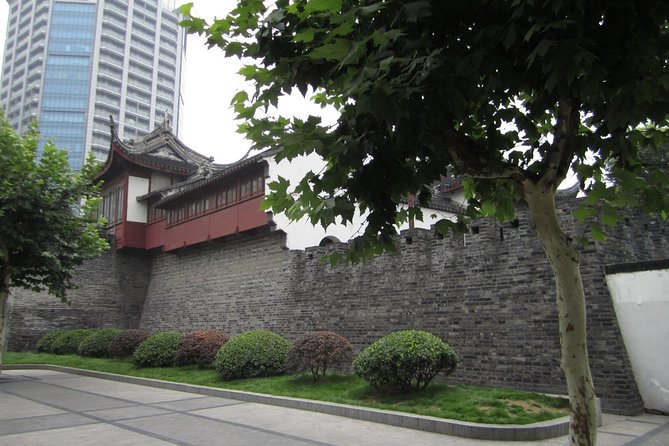
Shanghai built its city wall in 1553 during the Ming Dynasty to defend against Japanese pirates. The wall followed the route of today’s Renmin Lu and Zhonghua Lu. It measured about 8.1 meters high and stretched roughly 4.8 kilometers around the old city.
Only a section remains, so this is a compact stop of about 30 minutes. That limited time is appropriate for a surviving fragment rather than a complete fortification, but you should set your expectations correctly. You are not walking a full medieval circuit. You are seeing a piece of the defensive system that once defined old Shanghai.
This stop gives the tour an important Chinese historical anchor. The earlier residences reflect foreign influence and twentieth-century events. The wall takes you much further back, to a time when Shanghai needed physical defenses against attacks from the sea.
Admission is included. I like the way the stop connects the modern street plan to the old walled city. When you hear that Renmin Lu and Zhonghua Lu follow the wall’s former course, ordinary roads begin to make more sense. You can look at the present city and picture the smaller settlement that existed before Shanghai became an international port.
The Second National Congress site
The site of the Second National Congress of the Communist Party of China brings the political thread into sharper focus. The congress took place in Shanghai from July 16 to 23, 1922. Its decisions helped confirm the early direction and organization of the party.
The one-hour visit gives your guide room to explain why this meeting mattered. Dates and political titles can become dry when presented without context, so this is one stop where a strong English-speaking guide adds real value. The site is less about visual spectacle and more about understanding an event that influenced China’s later political system.
Admission is included. If you have little interest in modern Chinese history, you might find the stop demanding. If you want to understand the country beyond scenery and architecture, it is one of the most useful parts of the day.
The itinerary’s political sites also give balance to the colonial-era buildings. Shanghai is often presented through trade, foreign concessions, and grand commercial architecture. This stop reminds you that the city was also a setting for Chinese political organization and revolutionary activity.
Waibaidu Bridge and the changing waterfront
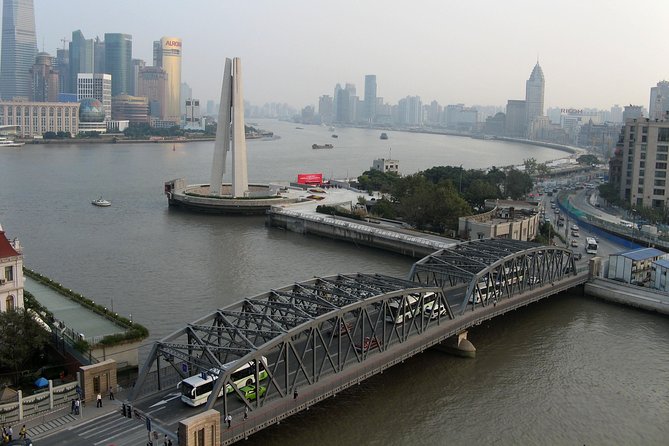
The final stop is Waibaidu Bridge, also called Garden Bridge in some English references. It is the first all-steel bridge in China and the only surviving example of a camelback truss bridge in the country. The present bridge opened on January 20, 1908.
The bridge is a strong closing point because it brings together engineering, transport, and Shanghai’s international past. Its steel construction reflects the city’s rapid modernization during the early twentieth century. Unlike a former residence, it is infrastructure, built to carry people and vehicles as the city expanded.
The information provided does not specify the exact length of this stop, so your guide will determine how much time to spend there within the full-day schedule. You can expect the bridge to be appreciated for its design and historical importance rather than as a formal museum visit.
It also provides a change of pace after the residences and political sites. Look at the structure itself, not only at the view around it. The camelback truss design is the unusual detail that makes this bridge worth seeking out.
Dumplings, transport, and the value of a private day
An authentic dumpling lunch is included. That is practical after a morning of sightseeing, and it adds a food element without turning the tour into a restaurant crawl. The available information does not name the restaurant or specify the exact dumpling style, so you should treat lunch as a included meal rather than a guaranteed specialty tasting.
The air-conditioned vehicle is another meaningful part of the price. Shanghai’s sites are spread across different parts of the city, and an eight-hour route can become tiring if you must organize every transfer yourself. Pickup is offered, and your group travels privately rather than sharing the vehicle with strangers.
At $175 per person, this is not the cheapest way to see Shanghai. The cost makes more sense if you value a private guide, door-to-door transport, historical explanation, and a full day built around less familiar places. It is less compelling if you prefer public transport, casual wandering, or choosing only one or two sites.
Group discounts may improve the price for larger parties. Since only your group participates, families and friends can also set the tone of the day more easily than on a large coach tour. Most people can participate, and service animals are allowed.
How the guiding can shape your day
The strongest personal praise connected with this experience focuses on Peggy. She is described as easy to get along with, highly fluent in English, helpful with photographs, and willing to help plan a distinctive wider visit to Shanghai.
Those details matter. A private tour can be excellent or merely expensive depending on how well the guide explains the places and handles the pace. Help with photos is a small but useful benefit, especially at visually striking sites such as Moller Residence, 1933 Old Millfun, and Waibaidu Bridge.
The current rating is 5 out of 5 from three ratings. That is an encouraging early signal, but it is still a small sample. I would treat the praise as a reason for confidence, not as proof that every guide or every day will feel identical.
Who should book this eight-hour experience
I would choose this tour if you want Shanghai history presented through places you might not find on a first-time sightseeing list. It suits you especially well if you enjoy architecture, political history, old urban defenses, and buildings with unusual former uses.
It is also a good fit for a first visit when you have a full day available and want more context than a simple landmark tour provides. The private format helps if your group includes people with different levels of interest, since you can ask questions directly and avoid a large-group schedule.
I would hesitate if you want a slow day. Six stops, lunch, and city transfers create a packed program. The ancient wall visit is only about 30 minutes, and the other stops are generally scheduled for an hour, so this is a survey of several important places rather than a long study of one neighborhood.
Book at least 24 hours before the start if you need the option of a full refund. Cancellations made less than 24 hours before the 9:00 a.m. start are not refunded, and changes inside that period are not accepted.
Should you book the Shanghai Uncommon Historic Sites Tour?
Book it if you want a private, well-organized day that explains how several different eras shaped Shanghai. The combination of Moller Residence, 1933 Old Millfun, Zhou Enlai’s residence, the Ming city wall, the Second National Congress site, and Waibaidu Bridge gives you a far broader picture than a sightseeing loop built only around famous views.
The best reason to choose it is the unusual mix. The biggest caution is the price and pace. At $175 per person, you are paying for private transport, a guide, lunch, and the convenience of a carefully linked full-day route. If that matches your priorities, this is a strong choice for history-minded visitors who want Shanghai to make more sense.
FAQ
How long does the Shanghai Uncommon Historic Sites Tour last?
The tour lasts approximately eight hours.
What time does the tour begin?
The scheduled start time is 9:00 a.m.
Is hotel pickup offered?
Yes. Pickup is offered.
Is this a private tour?
Yes. Only your group participates in the activity.
How much does the tour cost?
The listed price is $175 per person.
Is lunch included?
Yes. An authentic dumpling lunch is included.
Is transportation included?
Yes. An air-conditioned vehicle is included.
Are entrance fees included?
All fees and taxes are included. Admission is listed as included for the Shanghai Ancient City Wall and the Site of the Second National Congress of the Communist Party of China. The Moller Residence, 1933 Old Millfun, and Former Residence of Zhou Enlai list free admission.
Can service animals participate?
Yes. Service animals are allowed.
Can I cancel for a full refund?
Yes, if you cancel at least 24 hours before the experience start time. Cancellations made less than 24 hours before the start, and changes made within that period, are not accepted for a refund.
Just added in Shanghai
- Zhujiajiao Water Village: Private Tour from Shanghai★ 4.9 · 43 reviews
- Zhujiajiao with Private Customized Shanghai City Highlights★ 5.0 · 14 reviews
- Zhujiajiao & Shanghai:Private Day Tour Water Town to Skyline★ 5.0 · 12 reviews
- Zhujiajiao Water Town Private Tour with Night River Cruise★ 5.0 · 9 reviews
- Zhujiajiao & Shanghai:Small Group Tour Water Town to Skyline★ 5.0 · 4 reviews
- Yu Garden Shanghai Entry Tickets Booking And Trip★ 3.6 · 9 reviews
- Water Town Zhujiajiao Shanghai: Boat Ride,Sights,Bites&Sips★ 5.0 · 7 reviews
- shanghai Disney tour★ 5.0 · 12 reviews
Historical Tours, compared.
Between Capitalism & Communism: Hong Kong History Tip Based Tour
Read our review →
Beijing Historical Tour II including Summer Palace, Lama Temple & Panda Garden
Read our review →
Beijing Historical Tour I – Forbidden City, Tiananmen Square & Temple of Heaven
Read our review →
Tour of Jewish Shanghai led by a Jewish History Expert
Read our review →
Beijing Historic City Guided Walking Tour + Calligraphy Creation
Read our review →
Beijing Culture: Tea Ceremony, Heritage Instrument & Calligraphy
Read our review →
All inclusive Two-Day Xi’an private Heritage Tour
Read our review →
2-Hour Beijing Private Forbidden City Tour: History & Highlights
Read our review →Where else this tour turns up