
Reviewed · LHASA TOURS
Panorama Multi Day Tour in Tibet
Tibet rewards patience. This 11-day route links Lhasa’s great temples with Yamdrok Lake, Everest Base Camp, and Namtso Lake, while keeping the group to no more than 10 people. I like the promised roomy VIP setup, with more than 30 percent of seats left open, and the practical support from a local Tibetan agency, including the Tibet Travel Permit and an exclusive team doctor. The main catch is the altitude, rough roads, early starts, and long drives. This is not a gentle sightseeing holiday.
The city-center four-star hotels are another strong point, especially if you want Potala Palace and Jokhang Temple within roughly 1 to 3 kilometers. I also like the open time built into Lhasa, where you can walk around Barkhor Street instead of being marched from one stop to the next. Still, the route covers a lot of ground, and the schedule contains some long or tiring days that will suit active visitors better than anyone wanting a slow retreat.
In This Review
- Key points to know before booking
- What the $1,679 price really covers
- Arriving in Lhasa and taking it easy on day one
- Potala Palace, Jokhang Temple, and Barkhor Street
- Cuogao Lake, Basomtso, and the road to Nyingchi
- Nnamjagbarwa Mountain and Lulang Forest
- Kadinggou Waterfall and the forested gorge
- Yamdrok Lake, Karola Glacier, and Shigatse
- Tingri and the rough road to Everest Base Camp
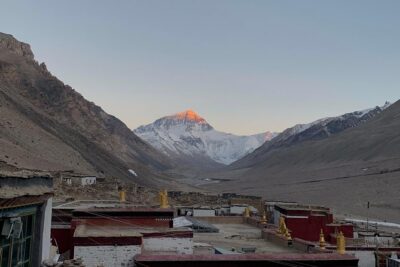
- Sunrise at Rongphu and the Everest Base Camp visit
- Tashilhunpo Monastery and the return toward Lhasa
- Namtso Lake and the final airport transfer
- Guides, service, and the small-group promise
- Who should book this Tibet route?
- FAQ
- How long is the Panorama Multi Day Tour in Tibet?
- What is the maximum group size?
- Is the Tibet Travel Permit included?
- Are flights or train tickets to Lhasa included?
- Are meals included?
- Can I cancel for a full refund?
- Should you book it?
Key points to know before booking
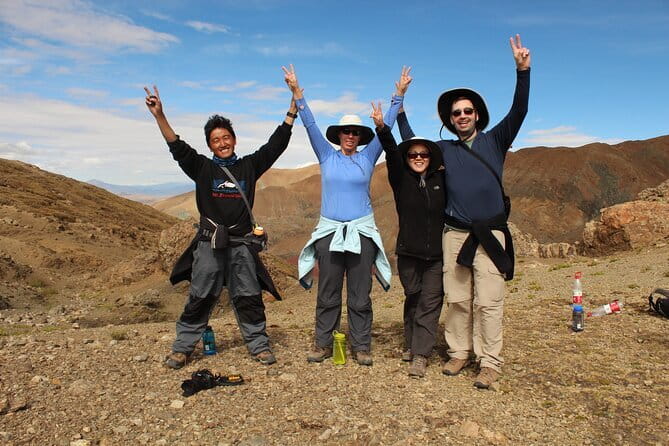
- Small group, maximum 10 people: The tour aims to keep more than 30 percent of vehicle seats empty, giving you more room on long mountain drives.
- Three major high-altitude lakes: You visit Cuogao, also described in the program as Basomtso, Yamdrok Lake, and Namtso Lake.
- Everest Base Camp is the big prize: The route includes Rongphu and a local bus transfer for the final approach to base camp.
- Tibet Travel Permit included: The local agency arranges this required permit as part of the package.
- Four-star city-center hotels: Your Lhasa lodging is placed within about 1 to 3 kilometers of Potala Palace and Jokhang Temple.
- The route is physically demanding: Expect passes above 4,500 meters, roads described as rough, and several days with about six hours of touring or driving.
What the $1,679 price really covers
At $1,679 per person, this is not a budget bus trip. But the price includes several costly and important pieces: four-star accommodation, licensed tourist vehicles, attraction tickets, breakfast on eight mornings, insurance, and the Tibet Travel Permit.
That permit matters. You cannot simply arrive in Tibet and travel around independently under this arrangement. Having the local agency handle it removes one major planning hurdle, especially if your route changes or your transport plans need coordination.
The price also includes airport or train-station pickup in Lhasa and a final transfer at the end. International transport is not included, and you buy your own flight or train ticket to Lhasa, though the agency can help with bookings. Lunches and dinners are also generally excluded, so you need a food budget beyond the headline price.
There is one detail I would clarify before paying: the inclusions list mentions dinner, but the exclusions say lunches and dinners are not included. Ask exactly which dinner, if any, is covered. The single-room supplement is listed as about $25 per day, which is modest for a private room, but you should confirm the final total.
The early booking plan may lower the rate, and group bookings can receive additional discounts. Since the tour requires a minimum number of people, ask what happens if that minimum is not reached. The stated policy offers a different date or experience, or a full refund, if the operator cancels for that reason.
A few more to weigh up in Lhasa
- Tibet Tour 8 Days Lhasa to Everest Base Camp Small Group Tour
★ 5.0 · 578 reviews - 7 Days Lhasa to Kathmandu Overland Small Group Tibet Tour via EBC
★ 5.0 · 188 reviews - 10 Days Tibet Everest Base Camp and Namtso Small Group Tour
★ 5.0 · 108 reviews
Arriving in Lhasa and taking it easy on day one
Your first day is built around arrival, pickup, and hotel transfer. A guide meets you in the arrival hall and takes you to your accommodation, with roughly six hours allocated to the arrival day.
That time does not mean six hours of sightseeing. It gives you room for the transfer, check-in, and settling down after reaching one of the world’s highest cities. The agency recommends certain flights, but you purchase your own ticket. You can also arrive by train, and one recent booking included a Chengdu to Lhasa journey on the Qinghai-Tibet Railway.
I would treat day one as a rest day. Avoid planning extra activities after arrival. The high elevation can affect even fit people, and the next morning brings Potala Palace, where you will want a clear head and steady legs.
Potala Palace, Jokhang Temple, and Barkhor Street
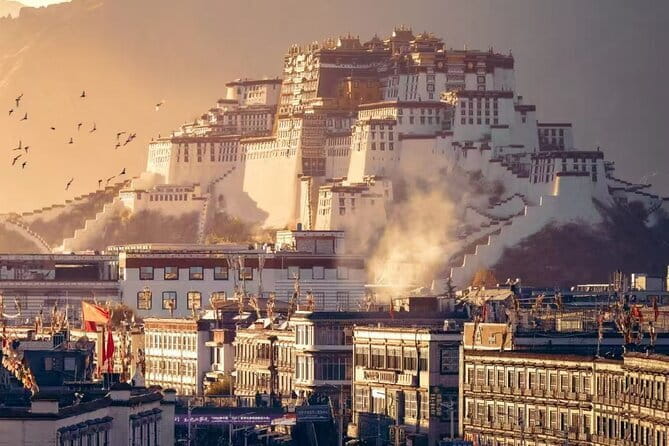
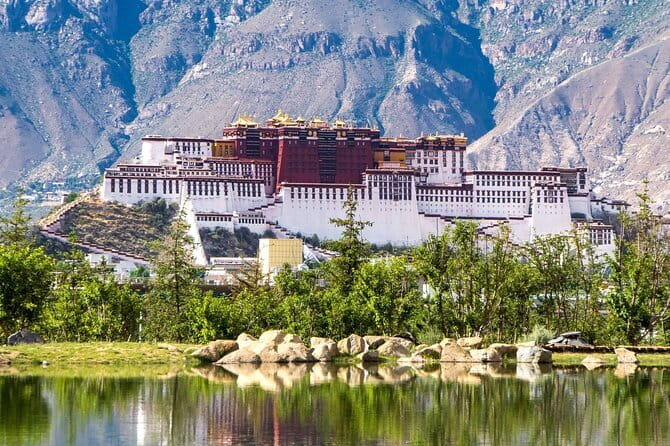
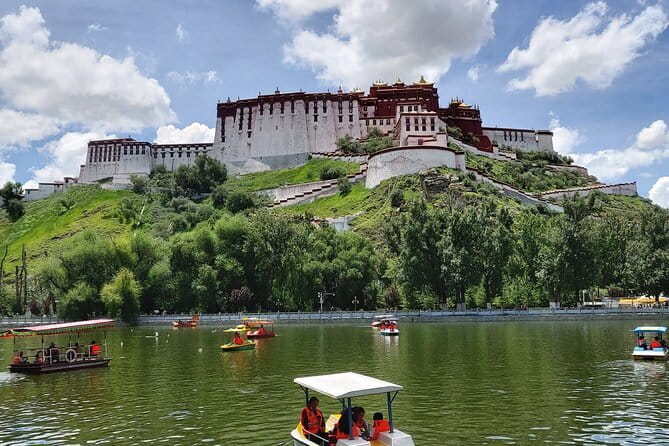
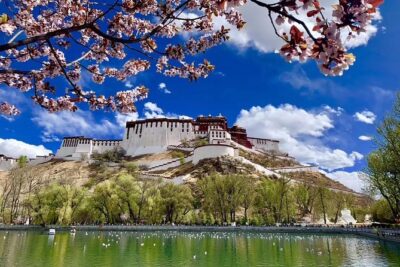
Day two gives Lhasa its proper introduction. In the morning, you visit Potala Palace for about three hours, with admission included.
Potala Palace served as the residence of the Dalai Lamas and the center of Tibetan political and religious authority. Its position above Lhasa makes it one of the world’s great city sights, but the visit is not just about a postcard view. The palace is a serious religious and historic site, with a schedule and access system that your guide will manage.
The practical issue is physical effort. You are visiting a high-altitude palace with stairs and enclosed interior spaces, so take the pace slowly. Keep water nearby and listen to your body. The tour includes a guide, which helps explain what you are seeing instead of leaving you to puzzle over rooms and symbols on your own.
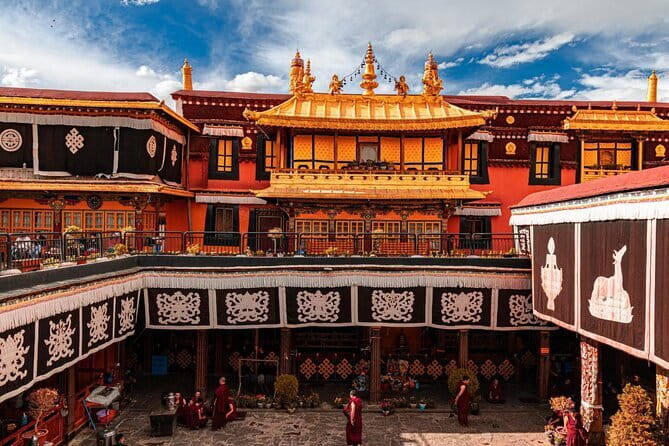
In the afternoon, the group visits Jokhang Temple for about three hours. This is the spiritual heart of Lhasa for Tibetan Buddhists. Its architecture brings together Tibetan, Tang, Nepalese, and Indian influences, giving the building a very different feel from Potala Palace.
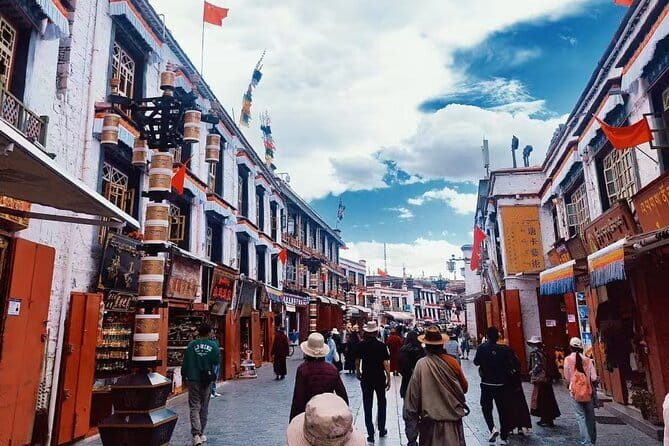
After the temple, you have time around Barkhor Street. Walk clockwise around Jokhang Temple, browse the handicraft market, or sit and watch the steady flow of local religious activity. This is one of the best parts of the schedule because it leaves room for observation rather than filling every minute with transport.
A recent booking specifically praised the time available for exploring independently. That detail matters. A guided visit gives you context, while free time lets you set your own pace, return to a corner you liked, or simply adjust to Lhasa.
Cuogao Lake, Basomtso, and the road to Nyingchi
Day three shifts from sacred buildings to mountain scenery. The program calls the first stop Cuogao Lake, while its description identifies Basomtso Lake in Gongbujiangda County. I would confirm the exact stop and spelling before departure, since these names are presented inconsistently.
The drive heads east from Lhasa along the Nyang River and crosses the 5,013-meter Mila Mountain Pass before descending toward Nyingchi. You get about three hours at the lake and another three hours around Nyingchi County.
That pass is a reminder of the tour’s scale. This is not a short outing from Lhasa. You are crossing high ground, then dropping toward river valleys and forest. The changing scenery is one of the best reasons to choose the full route, though the driving time will test anyone who dislikes sitting in a vehicle.
Nyingchi is described as the Throne of the Sun in Tibetan. The route follows the Nyang River Valley and reaches areas known for forests and mountain views. You will not spend the entire day walking, but the stops break up the drive and give you a wider sense of Tibet beyond the capital.
A completely different sort of day out:
- 4 Days Lhasa Impression Small Group Tour
★ 4.5 · 67 reviews - 6 Days Central Tibet Culture Small Group Tour
★ 5.0 · 53 reviews - 8 Days Lhasa Gyantse Shigatse Mt Everest Group Tour
★ 5.0 · 52 reviews - 4 Days Lhasa City Essential Group Tour
★ 5.0 · 25 reviews
Nnamjagbarwa Mountain and Lulang Forest
On day four, the group leaves Nyingchi early for Lulang, about 100 kilometers away and roughly two hours by road. The route crosses the 4,515-meter Segrila Mountain and offers views of forests and the Nnamjagbarwa Mountain area.
The schedule allows about three hours at Nnamjagbarwa Mountain and three hours around Lulang Forest. Lulang is described as a place where gods reside, with mountain slopes covered in untouched forest and open pasture below.
This is a softer visual change after the bare high passes around Lhasa. Forest, pasture, river valleys, and snow-covered peaks give the day a calmer rhythm. If you enjoy scenery photography, this is likely one of the most rewarding sections, but weather will affect what you can see. Mountain views are never guaranteed.
The early departure is worth noting. You will need to be ready before the day has fully warmed up, and the road schedule leaves little room for sleeping late. Bring layers rather than relying on one heavy coat. Conditions can change quickly at high elevation.
Kadinggou Waterfall and the forested gorge
Day five focuses on Kadinggou Scenic Spot, also described as Kadanggou Waterfall or Heavenly Buddha Waterfall. The name suggests a dramatic setting, and the description points to narrow gorges, deep valleys, high mountains, and primitive forest.
The program allows about six hours here, making it one of the less rushed days. That is welcome after the longer road sections. You have more time to take in the gorge scenery instead of stopping only long enough for a photograph.
The exact amount of walking is not specified, so ask your guide about the path and terrain if you have concerns. The tour requires moderate physical fitness, and uneven ground is possible at a natural scenic area. Comfortable shoes are a sensible choice.
Yamdrok Lake, Karola Glacier, and Shigatse
Day six returns to the high, open country. The route passes green farmland in the Nyangchu Valley, then reaches Yamdrok Lake and the Karola Glacier roadside viewpoint at about 4,960 meters before continuing west to Shigatse.
Yamdrok Lake is one of Tibet’s most memorable water stops, with broad mountain views and changing color depending on light and weather. The Karola Glacier adds a stark high-altitude contrast. You are not just moving between attractions here; you are watching the land change from farmland to exposed mountain terrain.
The day is assigned about six hours, and the road distance matters more than the clock suggests. Stop often, drink water, and keep snacks handy. Lunch is not included, so ask your guide where the group will stop and carry something you know you can eat.
Shigatse is Tibet’s second-largest city and an important religious center linked in the program with the Panchen Lama. It provides a useful change from Lhasa, though this section is still part of a demanding overland journey.
Tingri and the rough road to Everest Base Camp
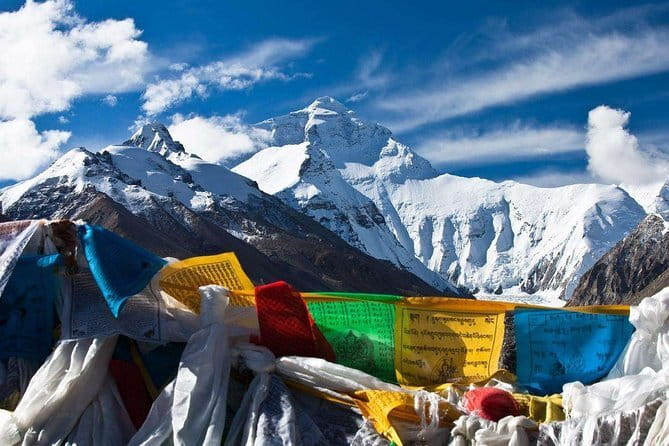
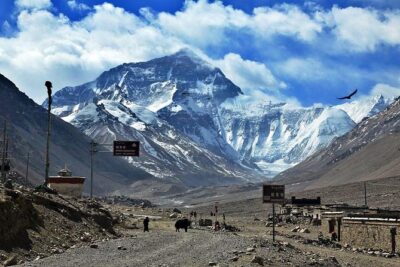
Day seven heads west along the Friendship Highway to Tingri and then toward Rongphu and Everest Base Camp. The road from Tingri to Rongphu is described as about 90 kilometers, bumpy, and under construction.
That warning should shape your expectations. The road is not a minor inconvenience. The route crosses wild grassland, rivers, and high mountains, and the final section can be very rough. You may spend more time looking out of a bus window than walking around.
In clear weather, the area can reveal four peaks higher than 8,000 meters. That possibility is a major reward, but it depends on visibility. Do not book this tour expecting a guaranteed perfect view of Everest.
The schedule gives about three hours in Tingri and three hours around the Qomolangma National Nature Preserve. The scenery is the point, and the road itself is part of the story. Still, this is where the small group and spare seats have real value. More room makes a rough ride easier.
Sunrise at Rongphu and the Everest Base Camp visit
Day eight begins early, with sunrise at Rongphu and views toward Mount Everest. The itinerary then describes a walk to the local bus, followed by about 30 minutes on the bus to Everest Base Camp.
This is the emotional high point for many people. Rongphu gives you a close connection to the Everest region, while the base camp visit places you at one of the world’s best-known mountain viewpoints. The experience depends heavily on weather, road conditions, and your response to altitude.
You should be prepared for a short night or pre-dawn start. Bring warm clothing, water, and patience. The schedule allows about five hours, but exact timing can shift with road conditions and local access.
Afterward, the route returns toward Tingri. The plan is not designed as a relaxed base-camp stay. It is a demanding mountain visit folded into a larger circuit.
Tashilhunpo Monastery and the return toward Lhasa
Day nine includes Tashilhunpo Monastery, described as the largest monastery in western Tibet. The visit is paired with a long drive toward Lhasa, with about six hours allocated to the day.
Tashilhunpo is a fitting final religious site after Potala Palace and Jokhang Temple. The three places offer different views of Tibetan religious life, from the former seat of the Dalai Lamas to the central temple in Lhasa and the major monastery near Shigatse.
The schedule wording is a little unclear about the exact overnight sequence after Everest. It refers to driving back to Lhasa from Shigatse, so confirm the night-by-night hotel plan before booking. This is a small but useful check on a route that covers many distant places.
Namtso Lake and the final airport transfer
Day ten brings one last major sight: Namtso Lake. You drive north through broad grasslands, pass prayer flags, and follow the Qinghai-Tibet Highway before crossing a 5,190-meter pass.
Namtso gives you a final dose of wide-open Tibetan scenery. The high pass is impressive but also reinforces the physical demands of this tour. After nine active days, you may feel tired, so do not underestimate the value of a quiet evening after returning.
Day eleven is checkout and transfer to Lhasa Airport or the train station. The driver collects you from the hotel after breakfast. If you are taking a train or flight, confirm your departure time early, since the route’s driving schedule can be affected by road conditions.
Guides, service, and the small-group promise
The strongest service detail comes from the agency’s willingness to coordinate complicated arrangements. Xue Yang, also called Gloria, is specifically praised for patiently handling months of questions, itinerary changes, hotel adjustments, and special arrangements.
That kind of support is valuable in Tibet, where permits, transport, altitude, and changing road conditions can complicate a trip. The tour also promises a team doctor, which adds reassurance on a route that reaches several very high passes.
The group cap of 10 is sensible. It is small enough for guides to keep track of everyone, but large enough to preserve the price advantage of a group trip. The promise of empty seats is especially useful during the long drives to Everest and Namtso.
The tradeoff is less freedom than a fully private tour. The schedule is shared, and the group must move together. If you want to change every hotel, add side trips, or linger at one viewpoint, a private itinerary may suit you better. One recent booking used a private tour and required several months of planning, showing that the same agency can handle more tailored arrangements.
Who should book this Tibet route?
I would choose this tour if you want to see the major sights in one organized trip and prefer having permits, hotels, vehicles, and attraction tickets handled together. It suits an active person who can manage high altitude, long drives, early mornings, and rough roads.
It is also a good match if you want some independence in Lhasa but do not want to organize every transfer yourself. The free time around Barkhor Street and the careful arrival support help keep the trip from feeling like one continuous guided march.
I would think twice if you need a slow pace, dislike basic road conditions, or want guaranteed mountain views. The tour covers a huge area, and the most dramatic sights depend on weather. Ask for clarification about the Cuogao and Basomtso naming, the dinner inclusion, and the hotel sequence after Everest before you pay.
The cancellation policy is useful but firm: cancel at least six full days before the start for a full refund, two to six days before for a 50 percent refund, and within two days for no refund. Cutoff times use local time.
FAQ
How long is the Panorama Multi Day Tour in Tibet?
The tour lasts approximately 11 days, beginning with arrival in Lhasa and ending with transfer to Lhasa Airport or the train station.
What is the maximum group size?
The maximum is 10 people. The tour also promises that more than 30 percent of vehicle seats will remain empty.
Is the Tibet Travel Permit included?
Yes. The Tibet Travel Permit is included in the tour price.
Are flights or train tickets to Lhasa included?
No. International transportation is excluded, and you purchase your own ticket to Lhasa. The agency can help with bookings and recommends suitable flights.
Are meals included?
Eight breakfasts are included. The information also lists dinner as included but says lunches and dinners are excluded, so you should confirm exactly which dinner is covered before booking.
Can I cancel for a full refund?
Yes, if you cancel at least six full days before the experience start time. Cancellations two to six full days before receive a 50 percent refund, while cancellations within two days are not refunded.
Should you book it?
Book this tour if your main goal is to see Potala Palace, Everest Base Camp, and Namtso Lake without managing Tibet’s permits and long-distance transport yourself. The local agency support, small group, roomy vehicle, four-star city hotels, and patient coordination from Xue Yang and Gloria add real value at $1,679.
Do not book it simply because the price looks neat on paper. First make sure you can handle the altitude and rough roads, then clarify the meal and hotel details. For a fit, flexible visitor who wants a broad first look at Tibet, this is a strong route with an unusually full itinerary.
Just added in Lhasa
- 6 Days Lhasa Gyantse Shigatse Group Tour★ 5.0 · 12 reviews
- 9 Days Lhasa Gyantse Shigatse Everest Namtso Group Tour★ 4.0 · 21 reviews
- 8 Day Tibet Classic Tour★ 5.0 · 5 reviews
- Private Guided Day Tour Potala Palace and Sera Monastery★ 5.0 · 22 reviews
- 4 Days Lhasa City Essential Group Tour★ 5.0 · 25 reviews
- 15 Days Mt Everest and Mt Kailash Kora Pilgrimage Group Tour★ 4.5 · 17 reviews
- 8 Days Lhasa Gyantse Shigatse Mt Everest Group Tour★ 5.0 · 52 reviews
- 6 Days Central Tibet Culture Small Group Tour★ 5.0 · 53 reviews
Lhasa Tours, compared.
Tibet Tour 8 Days Lhasa to Everest Base Camp Small Group Tour
Read our review →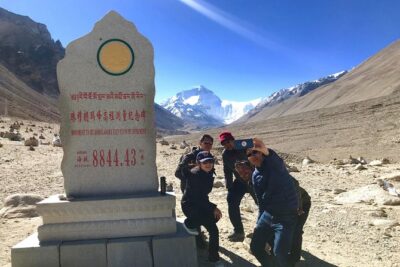
7 Days Lhasa to Kathmandu Overland Small Group Tibet Tour via EBC
Read our review →
10 Days Tibet Everest Base Camp and Namtso Small Group Tour
Read our review →
8 Days Lhasa Gyantse Shigatse Mt Everest Group Tour
Read our review →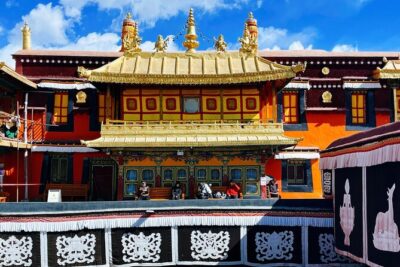
Private Guided Day Tour Potala Palace and Sera Monastery
Read our review →Where else this tour turns up