
Reviewed · FOOD & DRINK
The 10 Tastings of Hong Kong With Locals: Private Street Food Tour
Hong Kong tastes better on foot. This private food walk pairs 10 tastings with markets, old streets, and local transport, giving you a useful introduction to the city’s food culture without guessing what to order. I like the personal format and the chance to see dried seafood, Chinese vegetables, and everyday market life up close. The main consideration is the price: at $195.71 per person, this makes the most sense if you value a private guide and cultural context as much as the food.
I also like the range, from shrimp wontons and beef noodles to sugarcane juice, fruit, pineapple buns, and milk tea. Guides such as Angel, Cosmos, Ronnie, Ling, and Caleb have been praised for adding history, etiquette, neighborhood knowledge, and occasional tram rides. Food quality can vary by stop, though, and one poorly matched guide created a very uncomfortable experience, so clear meeting instructions and guide communication matter.
In This Review
- Key points to know before booking
- Why this private food tour works well in Hong Kong
- Starting near Sai Ying Pun and Sheung Wan
- One hour inside a Sheung Wan wet market
- Shrimp wontons near The Center
- Sugarcane juice and a family-run teahouse
- Graham Street Market and handpicked fruit
- Dai Pai Dong eating in Wan Chai
- Pineapple buns, milk tea, and the final tastings
- The Mid-Levels Escalator and Stone Slab Street
- The guides make or break the experience
- Is $195.71 per person good value?
- Who should book this Hong Kong food walk?
- Should you book it?
- FAQ
- How long does the private Hong Kong food tour last?
- How many tastings are included?
- Is the tour private?
- Are vegetarian alternatives available?
- Where does the tour start and end?
- What is the cancellation policy?
Key points to know before booking
- A private three-hour walk: You explore with only your own group and a local guide, allowing the pace and food choices to feel more personal.
- Markets are part of the meal: Sheung Wan and Graham Street show you dried seafood, Chinese vegetables, meats, and unusual ingredients before you taste your way through the neighborhoods.
- The food is varied: Expect shrimp wontons, beef noodles, exotic fruit, sugarcane juice, pineapple buns, milk tea, and other local samples, with vegetarian alternatives available.
- Hong Kong history comes between bites: The route includes the Mid-Levels Escalator, Stone Slab Street, Hollywood Mural, and areas around The Center and Wan Chai.
- You need reasonable walking stamina: The tour uses streets, markets, stairways or slopes, and public areas. Comfortable shoes are a must.
- Guide quality shapes the day: Angel, Cosmos, Ronnie, Ling, and Caleb have earned strong praise for warmth and local insight, while one reported guide experience was a serious exception.
Why this private food tour works well in Hong Kong
Hong Kong food can be easy to admire and hard to understand. Menus may be brief, crowded restaurants can move quickly, and unfamiliar ingredients appear everywhere, from dried sea cucumbers to birds’ nests. A local guide gives you a person to ask before you order and a reason to look beyond the most familiar dim sum.
The private setup is the real selling point. This is not a large group being hurried from one snack to the next. It is only your party and the guide, which gives you room to ask why a dish matters, how a market works, or what local etiquette to follow.
The route also gives you more than food. You pass through Sheung Wan, Central, Wan Chai, Graham Street Market, Stone Slab Street, and the Mid-Levels Escalator. That makes the tour useful early in a Hong Kong stay, when you want to get your bearings and learn how several parts of Hong Kong Island connect.
The score is 4.7 out of 5, with 91 percent recommending the experience. That is a strong result, but it should not lead you to expect a restaurant tasting menu. This is street food and everyday local eating, so the quality and atmosphere can vary from one stop to the next.
More Food Tours in Hong Kong
- Hong Kong’s Tin Hau Hidden Eats Food Tour with 7+ Local Tastings
★ 5.0 · 352 reviews - Small-Group Hong Kong Island Food Tour
★ 5.0 · 343 reviews - Hong Kong Food Tour: Central and Sheung Wan Districts
★ 5.0 · 333 reviews
Starting near Sai Ying Pun and Sheung Wan
The meeting information gives two nearby reference points: Sai Ying Pun MTR station, Exit B1, and the Eco Tree Hotel Sheung Wan at 156 to 160 Des Voeux Road West. Confirm the exact meeting place before setting out, since the written details use both locations.
The opening 20 minutes are for meeting your host and getting oriented. From there, the tour moves into Sheung Wan, one of the most useful places in Hong Kong for understanding the connection between food, trade, and daily life.
You are not simply walking past storefronts. The guide explains Chinese vegetables, meat, and the cultural role of a wet market. These markets can feel more revealing than a polished food hall because they show what people buy for ordinary meals.
One hour inside a Sheung Wan wet market
The market visit is the longest single stop, and rightly so. You have time to look at produce, meat, and unfamiliar ingredients rather than rushing through for a quick photograph.
A dry market visit is also part of the experience, with sea cucumbers, birds’ nests, and other preserved goods on display. These ingredients can seem strange or expensive when seen without context. Your guide can explain what they are used for and why they appear in Hong Kong’s food culture.
This is where the tour earns some of its cultural value. You learn to recognize ingredients before they arrive in a bowl, and you see the difference between food sold for home cooking and food prepared for immediate eating.
The drawback is that markets are working places, not staged attractions. Space can be tight, smells can be strong, and the pace may be brisk. If you dislike crowded indoor markets, this hour may feel more demanding than the tastings.
Shrimp wontons near The Center
The next food stop brings you close to The Center, one of Hong Kong’s tallest buildings. Here you eat shrimp wontons in a local lunch restaurant, often alongside local diners sharing the same compact space.
That setting matters. You are not being served a dish in isolation. You see how a quick Hong Kong meal works, how people share tables, and how little time many diners spend over lunch.
Shrimp wontons are a smart choice for a first food tour because they introduce a familiar style of Cantonese comfort food without requiring a brave leap into something obscure. The filling, wrapper, and broth each offer a simple way to discuss technique and taste.
Several guides have been praised for helping visitors understand local customs and food etiquette at stops like this. Ronnie, in particular, was praised for explaining Hong Kong life and helping make the city easier to navigate afterward.
A completely different sort of day out:
- Lantau Island Day Trip – Big Buddha & Tai O
★ 4.5 · 1,328 reviews - Big Bus Hong Kong Open Top Hop-On Hop-Off Sightseeing Tour
★ 4.0 · 1,077 reviews - Hong Kong Day Tour: City Landmarks & Highlights
★ 4.5 · 798 reviews - Hong Kong International Airport Plaza Premium Lounge Access
★ 3.5 · 787 reviews
Sugarcane juice and a family-run teahouse
The route then reaches the Hollywood Mural, with a stop for sugarcane juice at a scenic teahouse run by a fourth-generation family. This is one of the more distinctive details of the tour because it links a simple drink with a long-running local business.
Sugarcane juice is refreshing and sweet, but it is also a useful reminder that Hong Kong’s food culture is not limited to dim sum and roast meats. You get a drink that feels tied to street stalls and traditional refreshment culture.
The quality may not satisfy everyone. One assessment found the sugarcane juice too much like sugar water, so I would treat this as a cultural tasting rather than the guaranteed star of the tour. Your reaction may depend on how fresh and concentrated the serving is that day.
The nearby mural and old streets add visual interest between food stops. You get a short pause from eating while still seeing how old and newer Hong Kong meet in the same neighborhood.
Graham Street Market and handpicked fruit
At Graham Street Market, your guide selects exotic fruit for you to taste. This stop is brief, around 20 minutes, but it provides a change of texture and flavor after the wontons and juice.
The handpicked element is useful because you do not have to identify an unfamiliar fruit or choose one while standing in a busy market lane. Your guide can explain what you are eating and why it is popular.
Graham Street also gives you a street-level view of market life. Stalls, pedestrians, and food shopping take place in a compact setting, so the experience feels more immediate than a standard sightseeing stop.
Do not expect a long fruit tasting or a full market tour here. The stop is a quick sample woven into a larger walk. Its value comes from the combination of food, neighborhood atmosphere, and the guide’s explanations.
Dai Pai Dong eating in Wan Chai
Wan Chai brings the tour to the Dai Pai Dong experience, where you eat in the street with local diners. The featured dish is beef noodles, and the point is as much the setting as the bowl.
Dai Pai Dongs are associated with informal outdoor eating, quick service, and straightforward food. This is a good stop if you want to see how Hong Kong’s food culture works at street level rather than in a formal dining room.
A guide can help you understand how to sit, order, share space, and keep moving in a busy food district. That practical help is especially useful if you are not used to Hong Kong’s compact restaurants.
The route may also include a ride on an old double-decker tram, according to several descriptions of the experience. Treat that as a possible bonus rather than a guaranteed part of every departure, since transport details can depend on the guide and route.
Pineapple buns, milk tea, and the final tastings
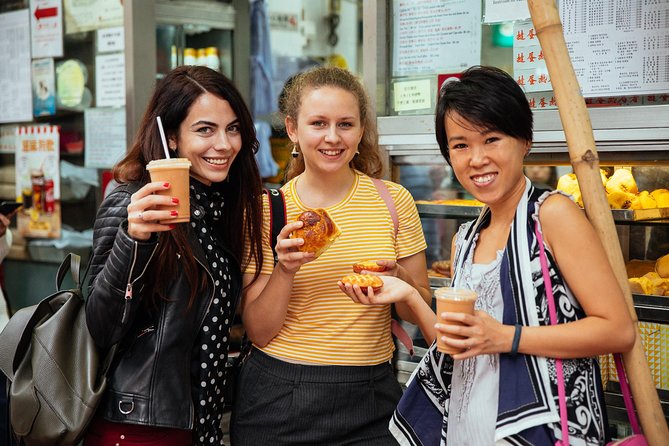
The last food stop features a Hong Kong favorite: pineapple bun with milk tea. Despite its name, the bun does not contain pineapple. Its appeal comes from the crisp, sugary top, which resembles pineapple skin.
This pairing is an excellent finish because it shifts the tour toward bakery food and a classic local drink. It also gives you something easy to remember and seek out later during your stay.
The schedule allows roughly 20 minutes here. If you are already full, you may prefer to eat slowly or take the item back with you. One account describes doing exactly that after several generous food stops, which is a useful reminder not to arrive after a large meal.
The tour promises 10 food and drink tastings, but the precise mix may change. The stated stops clearly include shrimp wontons, sugarcane juice, fruit, beef noodles, pineapple bun, and milk tea, while some accounts also mention dim sum and bakery items. Ask your guide at the start what the full tasting list will be that day.
The Mid-Levels Escalator and Stone Slab Street
Food is the headline, but the sightseeing links make the experience more useful. The Central to Mid-Levels Escalator and walkway system is the longest outdoor covered escalator system in the world. The tour uses about 15 minutes here, enough to experience this unusual piece of city infrastructure.
It is not just a ride. The escalator connects steep parts of Hong Kong Island and offers a practical look at how the city handles hills, dense housing, offices, and foot traffic.
Stone Slab Street adds a different feel. This sloped pedestrian street uses uneven granite slabs and is lined with market stalls. Wear shoes with a firm sole, since the surface is not smooth and the route involves regular walking.
These sights help break up the eating. They also give your guide a chance to explain how the neighborhoods fit together, which several highly rated guides did especially well. Cosmos, also identified as Cosmo, was praised for combining food with a wider walk through Soho, Hollywood Road, tram routes, and city highlights.
The guides make or break the experience
The strongest guide feedback centers on warmth, local pride, and the ability to explain food in plain language. Angel has been praised for discussing ingredients, dried seafood, religion, culture, and Hong Kong history. Ling was described as enthusiastic, friendly, and good at finding unusual food stops.
Caleb received praise for his interest in Hong Kong cuisine and culture, while Cosmos was singled out for humor, friendliness, and adding sightseeing beyond the scheduled tastings. Ronnie was especially valued for helping visitors understand local traditions, etiquette, and daily life.
That consistency is encouraging, but one reported experience with a guide named Matteo was very poor. The guide was said to be difficult to reach at the meeting point, unclear about the plan, dismissive when asked questions, and uncomfortable to spend time with. The provider apologized and invited follow-up.
This does not erase the many strong guide experiences, but it is a fair reason to confirm the meeting place and make your expectations clear. A private tour depends heavily on the person leading it. If the guide is warm and engaged, the walk feels personal. If not, the private format gives you no larger group to balance the mood.
Is $195.71 per person good value?
At $195.71 per person, this is not a cheap way to grab street snacks. You are paying for a private guide, 10 tastings, market access, neighborhood walking, and the convenience of having someone explain what you are seeing.
The value improves if you are a couple, family, or small group that wants personal attention. Group discounts may also help. A private guide can save you the cost of several wrong orders and help you find food you might never try alone.
The price is harder to justify if your only goal is quantity. Hong Kong has many affordable places to eat, and you can certainly spend less by exploring on your own. The tour makes more sense when you want a guided introduction, cultural context, and a short route through several districts.
Extra food and drinks are not included. The walk lasts about three hours, so plan to arrive hungry but not empty. Ten tastings can add up, especially when noodles, wontons, bakery items, and drinks are included.
Who should book this Hong Kong food walk?
I would recommend it to first-time visitors who want help making sense of Hong Kong food. It also suits people who enjoy markets, short walks, local restaurants, and trying small portions rather than committing to one large meal.
Families may appreciate the private format because the guide can explain choices and adjust the pace. Couples and small groups get a more relaxed conversation than they would on a large shared tour.
Vegetarians can request alternatives, and dietary restrictions are accommodated with substitutions. Still, tell the provider clearly before the tour so the guide can plan the tastings rather than improvise at each stop.
You should think twice if you have limited walking ability or dislike uneven streets, markets, and compact eating spaces. The stated requirement is moderate physical fitness, and the route includes slopes, market walking, and the Stone Slab Street surface.
Free cancellation is available up to 24 hours before the start time. After that point, the payment is not refunded, and late changes are not accepted.
Should you book it?
Book this tour if you want Hong Kong explained through food, not just photographed between major sights. The strongest reasons are the private guide, the market visits, the mix of savory and sweet tastings, and the chance to see how Sheung Wan, Central, and Wan Chai connect.
I would book it near the beginning of your stay. You can use the food advice, restaurant etiquette, neighborhood tips, and dish suggestions for the rest of your time in Hong Kong.
I would skip it if you are focused only on bargain eating or want a carefully controlled gourmet experience. For the price, the best return comes from the guide’s personality and local insight. Confirm the meeting point, mention dietary needs, wear good walking shoes, and arrive ready for a full meal in small portions.
FAQ
How long does the private Hong Kong food tour last?
The experience lasts approximately three hours.
How many tastings are included?
The tour includes 10 food and drink tastings. Listed examples include shrimp wontons, sugarcane juice, exotic fruit, beef noodles, pineapple bun, and milk tea.
Is the tour private?
Yes. Only your group and the local guide participate.
Are vegetarian alternatives available?
Yes. Vegetarian alternatives are offered, and dietary restrictions can be accommodated.
Where does the tour start and end?
The meeting information identifies Sai Ying Pun MTR station Exit B1 and the Eco Tree Hotel Sheung Wan at 156 to 160 Des Voeux Road West. The activity ends back at the meeting point, so confirm the exact starting location before departure.
What is the cancellation policy?
You can cancel at least 24 hours before the start time for a full refund. Cancellations or changes made less than 24 hours before the start time are not accepted for a refund.
Just added in Hong Kong
- Lantau Island: Priority Cable Car, Tai O & Direct Transfer★ 4.0 · 11 reviews
- Hong Kong: Lantau Private Coach, Tai O & Big Buddha Tour★ 4.8 · 8 reviews
- Hong Kong: Ngong Ping Private Cable Car Skip-the-Line Ticket★ 4.6 · 7 reviews
- From Hong Kong: Macau Day Tour with R/T Ferry, Lunch, Pickup★ 4.6 · 39 reviews
- Hong Kong Market Walking Tour & Chinese Cooking Class★ 5.0 · 24 reviews
- 4-Hour Private Hong Kong Layover Tour★ 5.0 · 39 reviews
- 6-Hour Private Hong Kong Layover Tour★ 5.0 · 18 reviews
- Private custom layover tour of Hong Kong – 7 hours★ 5.0 · 17 reviews
Food & Drink, compared.
Authentic Local Food Tour in Central Shanghai
Read our review →
Beijing Hutong Walking Food and Beer Tour at Hidden Restaurants
Read our review →
Hong Kong’s Tin Hau Hidden Eats Food Tour with 7+ Local Tastings
Read our review →
Hong Kong Food Tour: Central and Sheung Wan Districts
Read our review →Where else this tour turns up