
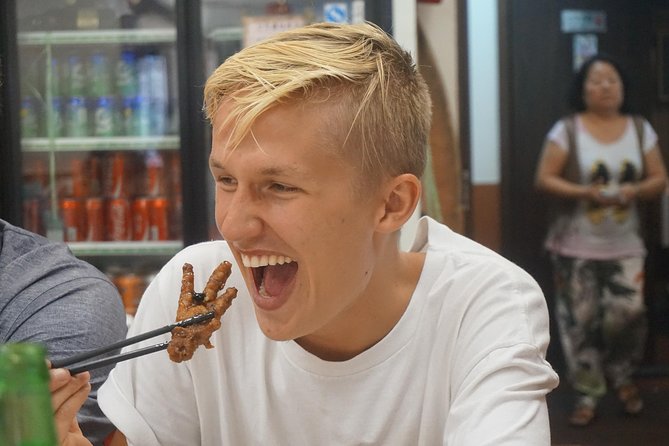
Reviewed · FOOD & DRINK
Private Food Tour: Hong Kong Island
Come hungry, leave better oriented. This four-hour private food tour links Hong Kong Island’s best-known neighborhoods with five classic bites, from trolley-served dim sum to a buttery egg tart. I like the small, family-run food stops and the way the route adds dried seafood shops, markets, temples, and old streets to the meal. I also like the private format, which lets your guide set a comfortable pace and explain the Cantonese and British influences behind each dish.
The main consideration is price: at $236.69 per person, this is a serious spend for a half-day of food. You also need to be comfortable eating seafood, gluten, meat, and dairy, since the tour is not suitable for vegetarians, people with gluten intolerance, or anyone with seafood allergies. The tram fare is extra, and hotel pickup is tied to a longer five-hour option rather than the standard walking tour.
In This Review
- Key points at a glance
- Why this food tour works so well
- Meeting in Sheung Wan with an empty stomach
- Trolley dim sum in an old Sheung Wan tea house
- Dried seafood, tea, and Sheung Wan’s old trades
- Graham Street Market and Central’s steep lanes
- Wonton noodles from a family-run shop
- Milk tea and the British side of Hong Kong
- Riding the Ding Ding to Wan Chai
- The Mid-Levels Escalator and Central’s changing face
- Roast meat and old Wan Chai
- Egg tart on Hennessy Road
- What the $236.69 price really buys
- Who should book this food walk?
- Guide quality and the private advantage
- Should you book it?
- FAQ
- How long is the Private Food Tour: Hong Kong Island?
- Where does the tour begin?
- Where does the tour end?
- Is hotel pickup included?
- What food is included?
- Do I need to eat breakfast before arriving?
- Is the tram fare included?
- Is this a private tour?
- Can people with dietary restrictions join?
Key points at a glance
- Breakfast begins with trolley dim sum: Start in Sheung Wan with a traditional yum cha meal in a tea house with nearly a century of local character.
- Five substantial tastings are included: Expect dim sum, wonton noodles, milk tea, roast meat with rice, and an egg tart, plus assorted sweets and local snacks.
- The route covers three very different districts: Sheung Wan, Central, and Wan Chai each show a different side of Hong Kong Island.
- Your guide shapes the private experience: Andy and Mel have received especially warm praise for their humor, English, pacing, food knowledge, and ability to adjust the day to a group.
- Public transport is part of the fun: The Mid-Levels Escalator and Ding Ding tram add useful local movement, though you pay the tram fare yourself.
- Come without breakfast: The portions add up, and the food is the center of the morning.
Why this food tour works so well
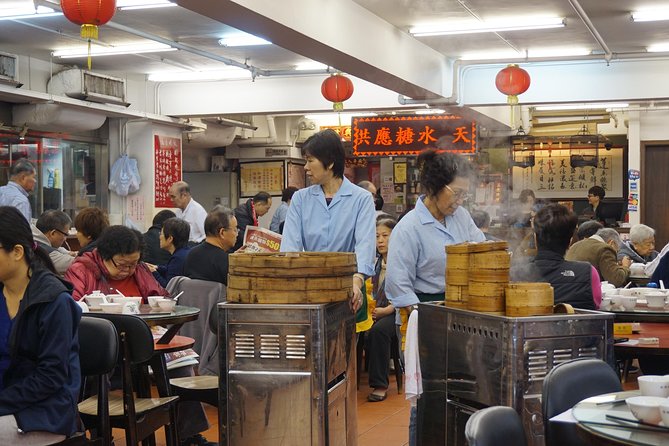
A food tour can easily become a parade of snacks with little sense of place. This one has a stronger design. You eat your way across Hong Kong Island while moving through old commercial streets, a wet market, a former colonial district, and neighborhoods where traditional businesses sit beside modern shops and restaurants.
I like that the food tells a clear story. Dim sum reflects Cantonese dining culture. Milk tea points to the city’s British period. The egg tart is a Chinese interpretation of an English custard pastry. Even the roast meat stop carries a local twist, with char siu and other roasted meats served with rice and homemade sauces.
The private setup matters, especially in narrow shops and busy markets. Your guide can pause to explain a display of dried seafood, answer questions about a dish, or adjust the pace for older members of your group. Andy has been praised for making the route comfortable for a group of four people over 65, while Mel has been praised for strong English, humor, and a flexible approach.
This is not simply a meal with a guide attached. It is a compact introduction to how Hong Kong eats and how its older neighborhoods developed.
More Food Tours in Hong Kong
- Hong Kong’s Tin Hau Hidden Eats Food Tour with 7+ Local Tastings
★ 5.0 · 352 reviews - Small-Group Hong Kong Island Food Tour
★ 5.0 · 343 reviews - Hong Kong Food Tour: Central and Sheung Wan Districts
★ 5.0 · 333 reviews
Meeting in Sheung Wan with an empty stomach
The standard meeting point is at 28 Des Voeux Road West in Sheung Wan. You receive directions after booking, and the area is close to public transportation. Hotel pickup may be available, but check the exact option carefully: the regular outing is still a walking and public-transport experience, not a private car tour.
The tour begins in one of Hong Kong Island’s most useful neighborhoods for first-time orientation. Sheung Wan mixes traditional Chinese businesses with newer cafés, shops, and restaurants. Its sloped streets can be busy and uneven, so sensible shoes are a good idea.
Do not eat breakfast before you arrive. The first stop is not a token sample. It is a proper dim sum breakfast, and the later tastings are substantial enough to make this a full half-day meal.
Trolley dim sum in an old Sheung Wan tea house
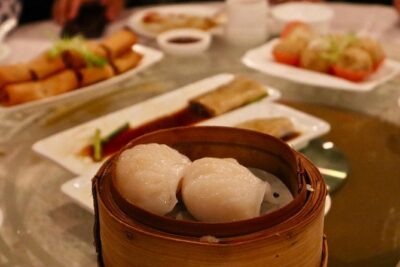
The opening stop is a tea house with a history stretching back nearly 100 years. Dim sum is served from a trolley, which gives the meal a more old-fashioned feel than ordering every item from a menu or tablet.
This is a good first taste of Cantonese dining. You can expect a variety of dim sum, though the exact selection can vary. The appeal is as much the setting and rhythm of the meal as the individual dumplings. The restaurant is described as lively and popular, so this may not be a quiet start.
Your guide can explain how yum cha fits into local life and help you make sense of the dishes. That is particularly useful if dim sum is new to you. The private format also gives you room to ask what you are eating instead of simply pointing at a trolley and hoping for the best.
For many people, this will be the high point of the food side of the outing. It combines a classic dish, an old local setting, and a meal that feels like part of daily Hong Kong rather than a staged tasting.
Dried seafood, tea, and Sheung Wan’s old trades
After dim sum, the route moves through Sheung Wan’s dried seafood area, often associated with Des Voeux Road West. Dried seafood is used in Chinese cooking and traditional tonics, and the shop displays offer a glimpse into a trade that can seem unfamiliar at first.
You may see ingredients that are difficult to identify without help. That is where the guide adds real value. Instead of treating the shops as scenery, your guide can explain how these products are used and why this part of Sheung Wan developed around them.
The stop at Kai Fat Tea adds a lighter taste. This narrow-road shop sells tea, assorted candies, and Chinese sweets made with fruit and other natural ingredients. You get to sample assorted candies and local snacks, so this portion breaks up the heavier dishes.
I would not think of these stops as filler. They give the meal a sense of place and show the commercial side of food culture, not just the polished dishes placed in front of you.
A completely different sort of day out:
- Lantau Island Day Trip – Big Buddha & Tai O
★ 4.5 · 1,328 reviews - Big Bus Hong Kong Open Top Hop-On Hop-Off Sightseeing Tour
★ 4.0 · 1,077 reviews - Hong Kong Day Tour: City Landmarks & Highlights
★ 4.5 · 798 reviews - Hong Kong International Airport Plaza Premium Lounge Access
★ 3.5 · 787 reviews
Graham Street Market and Central’s steep lanes
The route continues toward Graham Street Market, one of the oldest market areas on Hong Kong Island. Its sloping street is lined with stalls selling vegetables, seafood, and other daily cooking supplies.
This is a useful place to watch ordinary shopping rather than seek out a formal attraction. The market is compact, active, and practical. It also helps explain where the ingredients behind the earlier meals come from.
From here, the walk reaches Central. Central and the Western District combine old temples, narrow alleys, steep streets, colonial buildings, and high-rise commerce. The contrast can be striking, but the tour keeps its attention on food and neighborhood life rather than trying to cover every landmark.
The route may also pass Gough Street, where older architecture, boutiques, and restaurants share the same streetscape. Tai Kwun, the restored Central Police Station compound, is another possible point of interest along the route. These places add context, but keep your expectations clear: the included admission is generally free, and the tour is not designed as a full museum visit.
Wonton noodles from a family-run shop
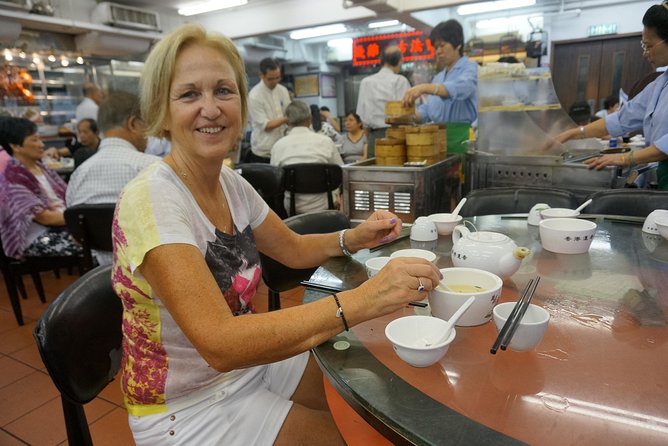
One of the most focused food stops is a family-run shop dating from the 1960s. It has been recommended in the Michelin Guide and is known for wonton noodles, a dish that looks simple but depends on careful preparation.
This is the sort of meal where a guide’s explanation helps you notice details you might otherwise miss. The dish combines noodles, wontons, broth, and toppings in a compact bowl, but the balance matters. The point is not novelty. It is seeing how a familiar local staple can be refined by a specialist.
The shop’s small scale is part of the charm, though it may also mean a tighter setting. If you prefer large, relaxed restaurants with plenty of personal space, this stop could feel less comfortable. For an authentic food route, though, the family-run setting makes more sense than a polished dining room.
Milk tea and the British side of Hong Kong
The traditional milk tea stop is brief, but it carries a lot of cultural weight. Milk tea became one of Hong Kong’s most familiar drinks through the city’s British connections, and it remains an everyday part of local food culture.
The drink offers a useful bridge between the Cantonese dishes and the later egg tart. Hong Kong food is not neatly divided into Chinese and Western categories. It often adapts outside influences into something distinctly local.
This is also a welcome pause between heavier tastings. You can ask your guide about the city’s food heritage while walking through Central, rather than trying to absorb every fact while eating noodles.
Riding the Ding Ding to Wan Chai
The route includes a ride on Hong Kong’s electric tramway, widely known as the Ding Ding. The system began operating in 1904 under British rule and is known for its double-decker trams.
The ride costs extra, so bring a small amount for the fare or confirm the current payment method with your guide. The tram is not just transportation. It gives you a street-level view as the route shifts from Central toward Wan Chai.
The ride is listed at about 20 minutes, while the overall route also includes a section on the Mid-Levels Escalator. Timing may shift depending on traffic, restaurant pace, and the group’s walking speed. That is one reason the private format helps.
The Mid-Levels Escalator and Central’s changing face
The Mid-Levels Escalator covers roughly 800 meters and rises about 135 meters. The ride takes around 15 minutes and offers a simple way to experience the city’s steep geography while watching street life pass by.
You are not sitting in a tour bus looking at Hong Kong from behind glass. You are moving through the city with shops, lanes, and changing street scenes close at hand. The escalator also saves your legs on the uphill section, though the tour still involves plenty of walking.
The route may include Tai Kwun, the restored Central Police Station compound. It now houses heritage, contemporary art, performing arts, and lifestyle venues. Since this food tour is only about four hours, you should not expect time to explore the entire complex in detail. Think of it as a cultural landmark along the way.
Roast meat and old Wan Chai
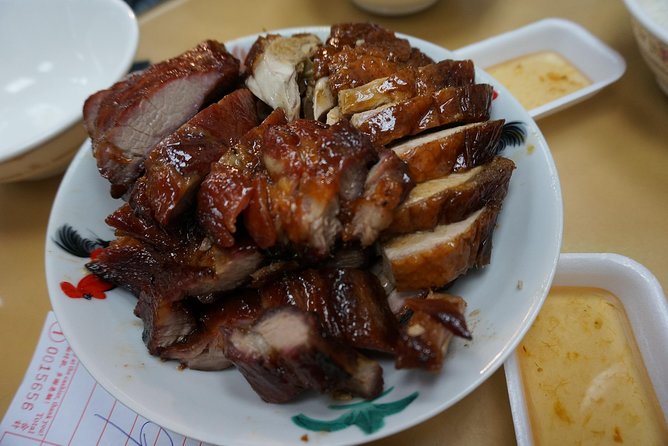
In Wan Chai, the food focus turns to roast meat. The family-run restaurant dates back to the Qing dynasty and is known for English roast meat, including char siu. You sample a mixture of traditional roasted meats with rice and homemade sauces.
This is likely the heaviest savory course, so the warning about skipping breakfast is worth taking seriously. The meal shows another side of Hong Kong cooking, where roast meats are prepared with precision and served in a straightforward, satisfying format.
Wan Chai itself gives the route a strong finish before dessert. The district mixes old tenement buildings, small temples, newer restaurants, and nightlife. It is one of the city’s best areas for seeing old and new side by side, without needing to leave Hong Kong Island.
Egg tart on Hennessy Road
The final food stop is a well-established bakery on Hennessy Road. Here you finish with an egg tart, called dan tat in Cantonese, a local version of the English custard tart.
The bakery has about 60 years of history and was a former Hong Kong governor’s personal favorite. That detail gives the stop a bit of character, but the real appeal is practical: the egg tart is an easy, recognizable dessert after a series of savory dishes.
The tour ends in Wan Chai, with Southorn Playground listed as another nearby point of interest. It is a public recreation area where office workers, sports players, spectators, and local residents gather. The finish feels grounded in daily life rather than wrapped up at a grand landmark.
What the $236.69 price really buys
At $236.69 per person, this is not an inexpensive way to eat in Hong Kong. You could certainly spend less by ordering dim sum, noodles, milk tea, roast meat, and an egg tart on your own.
The value comes from the private guide and the organization. You are paying for someone to connect the dishes to the neighborhoods, translate local food customs, handle the route, and adjust the pace for your group. You also receive several tastings, a public-transport segment, and a tailored introduction to Hong Kong Island.
The price is easier to justify for a small private group that wants a smooth first day, has limited time in port, or values personal explanation. One family of four used the outing during a cruise stop and arranged comfortable transportation around it. For a solo diner or a couple focused only on the cheapest meals, the cost may feel high.
Group discounts may be available, so check the final price for your party rather than assuming the per-person figure is fixed.
Who should book this food walk?
I would recommend it most strongly to:
- First-time visitors who want a quick introduction to Hong Kong Island
- Cruise passengers with one day in port
- Families and older adults who prefer a private pace
- People curious about Cantonese food but unsure where to start
- Small groups that want a guide who can adjust the route and explanations
It is less suitable if you are vegetarian, gluten-free, allergic to seafood, or uncomfortable with meat and dairy. The listed foods include dim sum, wonton noodles, milk tea, roast meat, and egg tart. Tell the operator about children before booking, since the tour asks you to provide that information.
The route is also not a car tour. Even with pickup arranged through the appropriate longer option, you will walk and use public transportation. Wear comfortable shoes and keep your schedule flexible.
Guide quality and the private advantage
The strongest part of the experience is the guide. Andy has been praised for humor, excellent English, strong local knowledge, and a pace that worked well for four older adults. Mel has been praised for making food, history, and culture easy to follow, while also customizing the outing around a family’s preferences.
Those details matter because the route crosses busy districts and includes several compact businesses. A rushed guide could turn this into a sequence of bites. A good one can make the same sequence feel like a connected story about Hong Kong.
Since this is a private activity, only your group participates. That gives you more control than a large food walk, but the quality depends heavily on the guide assigned to you. If you have priorities, such as more food explanation, a slower walking pace, or extra neighborhood context, mention them when arranging the tour.
Should you book it?
Book this tour if you want a guided first taste of Hong Kong Island, not merely a list of restaurants. The food is varied, the neighborhoods are well chosen, and the private format is especially useful for families, cruise passengers, and anyone who wants clear explanations without a large group.
Skip it if you are seeking a cheap self-guided food crawl, need a vegetarian or allergy-friendly menu, or dislike walking and public transportation. For everyone else, the best reason to book is the combination of substantial classic dishes and a route that makes Sheung Wan, Central, and Wan Chai easier to understand. Free cancellation is available up to 24 hours before the start time, which gives you some room to adjust plans.
FAQ
How long is the Private Food Tour: Hong Kong Island?
The tour lasts approximately four hours.
Where does the tour begin?
The standard meeting point is 28 Des Voeux Road West in Sheung Wan, Hong Kong.
Where does the tour end?
The tour ends in Wan Chai, with the final egg tart served as dessert.
Is hotel pickup included?
Hotel pickup may be offered, but the standard tour remains a walking and public-transport outing. Hotel pickup and drop-off are included only with the five-hour option that specifically includes pickup.
What food is included?
The tastings include assorted dim sum, wonton noodles, traditional milk tea, BBQ or roast meat with rice, and an egg tart. Assorted candies and local snacks are also included.
Do I need to eat breakfast before arriving?
No. You are advised not to eat breakfast before the tour because the food tastings together make a substantial meal.
Is the tram fare included?
No. The Hong Kong tram ride is at your own expense.
Is this a private tour?
Yes. Only your group participates in the activity.
Can people with dietary restrictions join?
The tour is not suitable for vegetarians, people who need gluten-free food, or people with seafood allergies. You should also inform the operator if you are traveling with children.
Just added in Hong Kong
- Lantau Island: Priority Cable Car, Tai O & Direct Transfer★ 4.0 · 11 reviews
- Hong Kong: Lantau Private Coach, Tai O & Big Buddha Tour★ 4.8 · 8 reviews
- Hong Kong: Ngong Ping Private Cable Car Skip-the-Line Ticket★ 4.6 · 7 reviews
- From Hong Kong: Macau Day Tour with R/T Ferry, Lunch, Pickup★ 4.6 · 39 reviews
- Hong Kong Market Walking Tour & Chinese Cooking Class★ 5.0 · 24 reviews
- Private custom layover tour of Hong Kong – 7 hours★ 5.0 · 17 reviews
- A Perfect Hong Kong Layover – 5h private tour★ 5.0 · 10 reviews
- 4-Hour Private Hong Kong Layover Tour★ 5.0 · 39 reviews
Food & Drink, compared.
Authentic Local Food Tour in Central Shanghai
Read our review →
Beijing Hutong Walking Food and Beer Tour at Hidden Restaurants
Read our review →
Hong Kong’s Tin Hau Hidden Eats Food Tour with 7+ Local Tastings
Read our review →
Hong Kong Food Tour: Central and Sheung Wan Districts
Read our review →Where else this tour turns up