
Reviewed · MASSAGE & RELAXATION
Chongqing: Active Wellness, Monorail, and Hidden Gems Tour
Chongqing rewards curious feet. This eight-hour private tour links quiet gardens, old neighborhoods, cliffside paths, and the famous Liziba train, giving you a fuller picture of the city than a quick photo stop. I especially like the chance to practice Baduanjin with a Tai Chi master and the visit to Erchang Culture and Creative Park, where old factory buildings now hold local design shops. The main drawback is the amount of walking, often on hills and uneven paths, so this is not a soft option for anyone with mobility limits.
I also like the personal scale. Your guide can explain Chinese garden design, help with local food, and adjust the pace more easily than a large group tour. Guide Tian has been praised for speaking English and Italian well, being patient, and making meet-up simple. Food and drinks are not included, so you should budget extra for lunch, but that also leaves room to choose between simple local dishes and a less-spicy hotpot.
In This Review
- Key points at a glance
- Why this Chongqing day feels different
- Eling Park begins the morning among ponds and pavilions
- Erchang Culture and Creative Park gives old factories a new role
- A residential neighborhood brings out vintage Chongqing
- Liziba shows Chongqing’s most improbable railway
- The cliffside walkway reveals Chongqing in layers
- An old park and springtime monorail add quieter moments
- Baduanjin closes the day with movement, not another viewpoint
- Transport, timing, and what you should bring
- Who will get the most from this $166 tour
- Should you book it?
- FAQ
- How long does the Chongqing wellness and hidden sights tour last?
- What is included in the tour price?
- Is lunch included?
- Which languages are available?
- Is the tour private?
- How often does the Liziba monorail appear?
- Is the Baduanjin class suitable for beginners?
- What should I bring?
- Can I cancel the tour?
Key points at a glance
- Baduanjin with a Tai Chi master: Learn the simple Eight Silken Movements in a Taoist sanctuary, with a national master and Intangible Cultural Heritage inheritor.
- Liziba’s train-through-a-building view: Watch the monorail pass through the eighth and ninth floors of an apartment building from a viewing square across the street.
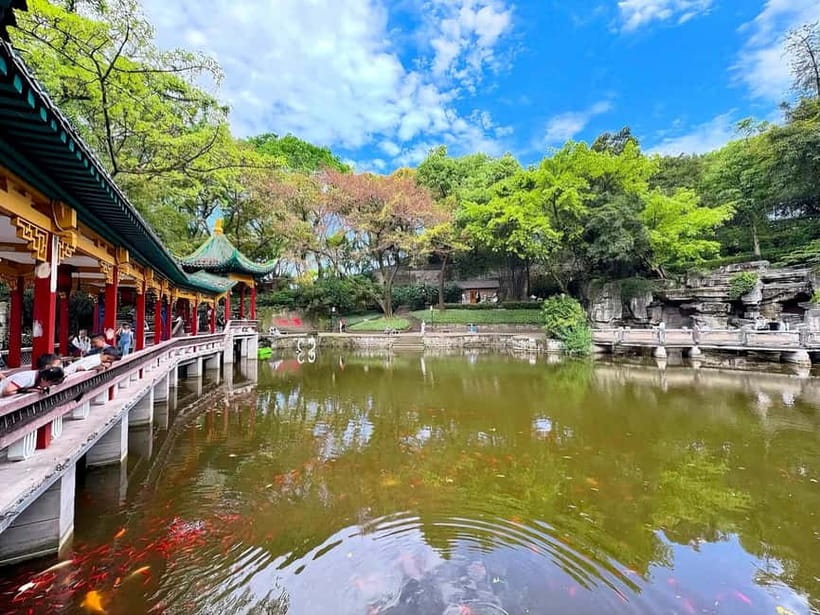
- Eling Park and Chinese garden design: Start among ponds, rocks, and pavilions while your guide explains the ideas behind eastern and western gardens.
- Erchang’s creative factory setting: See former industrial halls reused as a home for independent design, handcrafted jewelry, and upcycled clothing.
- Cliffside Chongqing views: Walk along a mountain path with a clear look at the city’s stacked buildings and steep river valleys.
- A flexible private outing: Travel by public transport with Didi or by chartered car, with multilingual guiding in English, Traditional Chinese, French, Italian, or Spanish.
Why this Chongqing day feels different
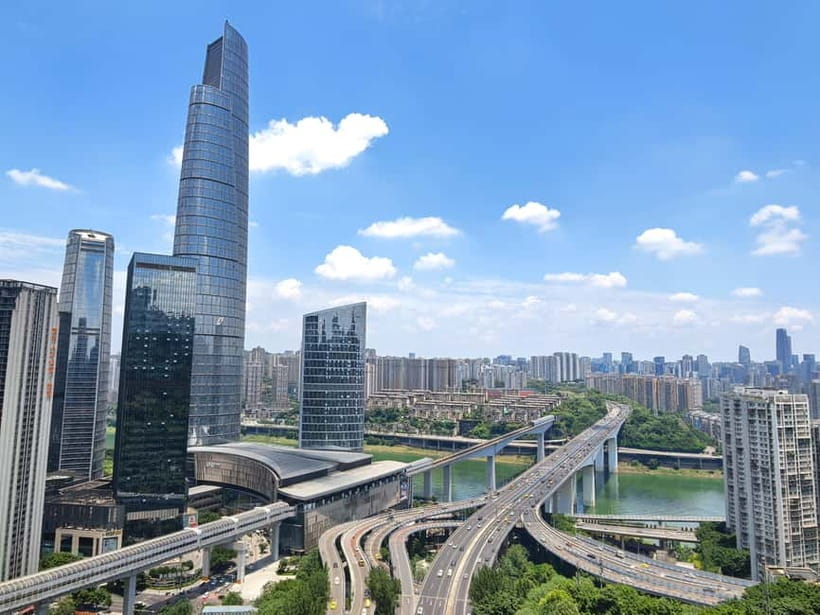
Many city tours rush from one famous sight to another. This one takes a slower, more varied route through Chongqing’s everyday character. You get grand views, but you also see a local garden, a former factory, a residential district, an old park, and a Taoist place of practice.
That mix matters in Chongqing. The city is famous for dramatic buildings and trains, yet its personality also appears in its steep lanes, compact neighborhoods, tea culture, and public spaces. This tour gives you time to notice those smaller details.
The private format is a real advantage. You are not tied to a large group’s pace, and a live guide can explain what you are seeing as the day changes from garden to factory to hill path. The available languages are English, Traditional Chinese, French, Italian, and Spanish.
At $166 per person, the tour is not a budget sightseeing walk. Its value depends on what you want from the day. You are paying for eight hours, a private guide, transport by public transportation with Didi or a chartered car, a Baduanjin and Tai Chi session, tea, small temple gifts, and several stops that are awkward to combine on your own.
Food is extra, as are insurance and any cost not listed. That is worth noting before you book. If you want a private, guided day with active sightseeing and cultural context, the price can make sense. If you only want Liziba and a city viewpoint, you can spend much less by visiting those places independently.
A few more to weigh up in Chongqing
- Chongqing Wulong National Park Private Tour
★ 5.0 · 87 reviews - Chongqing: Two Rivers Night Cruise- Yangtze & Jialing Rivers
★ 4.5 · 64 reviews - Chongqing deep explore & private car service including meals
★ 4.9 · 51 reviews
Eling Park begins the morning among ponds and pavilions
The day starts in Yuzhong District, then moves to Eling Park for about an hour. This is a strong opening because it shows you a quieter side of central Chongqing before the more famous sights arrive.
The park’s Chinese garden is built around deliberate placement. Rocks, ponds, pavilions, and paths are arranged to shape the way you see each scene. Your guide explains Chinese garden aesthetics and can compare eastern and western approaches to garden design. That turns a pleasant walk into something more useful: you begin to understand why a view feels balanced instead of merely pretty.
You will have time for photographs and scenic views, but this is not only a lookout stop. Pay attention to the transitions between open areas and enclosed corners. In traditional Chinese garden design, a wall, rock, or curved path can hide part of the view and encourage you to keep walking.
The park also involves walking, including paths that may slope. Comfortable shoes are important from the beginning, not just for the later cliffside walk. Bring water, and consider insect repellent as requested in the tour information.
Erchang Culture and Creative Park gives old factories a new role
A roughly 15-minute ride takes you to Erchang Culture and Creative Park. You spend about 30 minutes walking through a former industrial site that has been given a creative purpose.
The appeal here is the contrast. Old factory halls provide the setting, while independent designers sell handcrafted jewelry and upcycled fashion. You are not simply looking at preserved industrial buildings. You are seeing how an old worksite can be used again for contemporary art and small local businesses.
This is also the place to try a fresh local tea beverage, included as one cup per person. It makes a useful pause before the next walking section. If you enjoy design, photography, or adaptive reuse of old buildings, you may wish this stop were longer. The planned visit is brief, so browsing the boutiques will be limited.
Still, the short stop keeps the day moving. It also gives you a different view of Chongqing, one that has nothing to do with skyscraper views or famous transport systems.
A residential neighborhood brings out vintage Chongqing
The next stop is described as a secret stop in a local residential area. You walk for about 30 minutes and get a taste of older Chongqing away from the main sightseeing circuit.
The value here is the ordinary setting. You can see the feel of a lived-in neighborhood and sample authentic local food with a milder flavor. Chongqing cuisine is often associated with heavy spice, so this is useful if you want local dishes but do not handle strong heat well.
Lunch lasts about an hour at a local restaurant or food stop. The cost is not included, and you can arrange an authentic simple lunch or choose a non-spicy-friendly hotpot option through the available add-ons. Ask your guide for help with ordering, especially if you have dietary concerns or want to keep the meal mild.
Do not expect a formal restaurant experience or a long culinary class. This is a practical local-food break. You get time to eat, rest, and ask about the dishes, then return to sightseeing.
A completely different sort of day out:
- Chongqing: 1-day Essential Guided City Tour without Car
★ 5.0 · 44 reviews - Chongqing private luxury city tour: Must-sees All in One
★ 5.0 · 39 reviews - Chongqing: Magic Night View and Secret Viewing Spots Tour
★ 5.0 · 27 reviews - Chongqing Wulong: All inclusive luxury private trip to 2 spots
★ 5.0 · 26 reviews
Liziba shows Chongqing’s most improbable railway
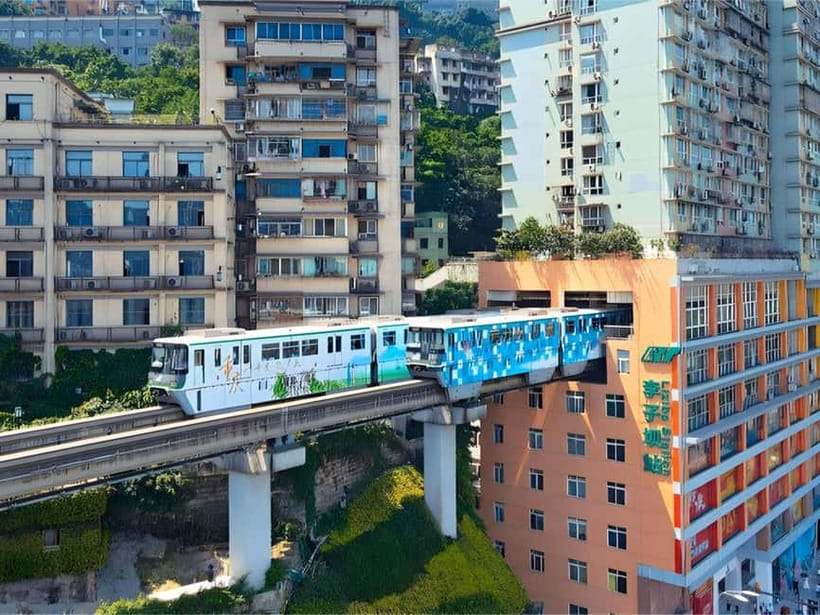
After lunch, you visit Liziba Viewing Platform for about 30 minutes. This is the tour’s most instantly recognizable sight: a monorail train passes through an apartment building.
The train runs through the eighth and ninth floors of the residential complex, with the viewing area across the street. It is a genuine piece of Chongqing engineering, not a trick created for photographs. The train appears every four to six minutes, so you normally do not need to wait long for the shot.
The viewing platform is small and focused. You will probably spend your time checking the tracks, watching the building, and preparing your camera for the next train. Your guide can explain the arrangement and help you get the timing right.
This stop can feel crowded or quick because the main attraction is one precise event. That is not a flaw, but you should set your expectations. Liziba is best understood as a short, memorable stop within a broader day, not a place where you will spend hours.
The train-through-building image also says something about Chongqing itself. Limited flat ground has encouraged dense, inventive construction, and the city’s transport system often appears to share space with apartment blocks, roads, and steep hills.
The cliffside walkway reveals Chongqing in layers
A subway or metro transfer of about 35 minutes leads to another part of the city. Then you walk for roughly 40 minutes through a less obvious park area, including a path built into the mountain cliff.
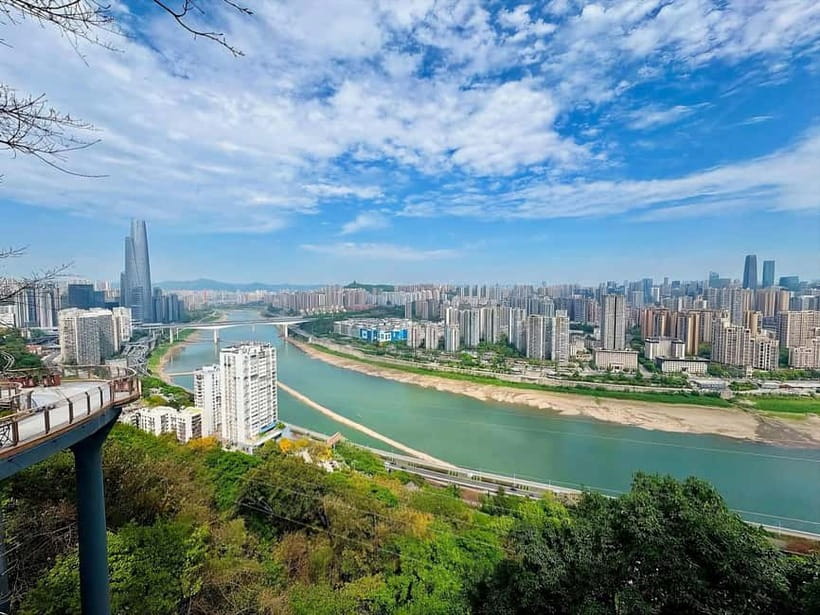
This is one of the day’s strongest photo sections. Chongqing’s buildings appear stacked across steep hills, with modern towers rising from river valleys and roads threading through the slopes. From the walkway, the city can look almost like blocks placed one above another.
The viewpoint is valuable because it helps you read Chongqing’s unusual shape. This is not a flat city with a distant skyline. The steep terrain affects nearly every view, every route, and much of the city’s architecture.
The practical warning is simple: wear shoes with a firm sole. The tour involves walking on hills and paths, and it is specifically not suited to people with mobility impairments or wheelchair users. The activity is also not recommended for people with epilepsy or those over 80. Those rules may feel strict, but the combination of uneven walking, stairs or slopes, and a full day makes the concern understandable.
Take your time with photographs, but keep your balance and follow your guide’s directions near cliffside sections. The appeal is the sense of space, not rushing to collect another picture.
An old park and springtime monorail add quieter moments
The route continues through an ancient park reached by narrow alleys. Tourists rarely come this way, which gives the stop a more local feel than the major viewing platforms.
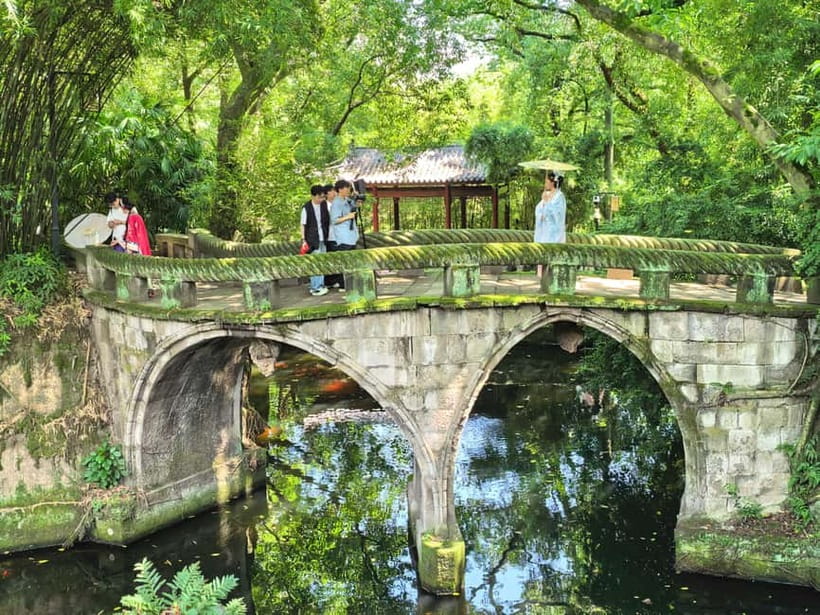
Three-dimensional sculptures tell stories about Chongqing as a port city built on hills. They add context to the city’s difficult geography and long connection with river transport. Instead of seeing only the modern towers, you get a visual reminder that Chongqing developed around water, trade, hills, and tightly packed routes.
One especially unusual sight is the Monorail to Spring, where a bright train moves past seasonal flowers and urban buildings. The name captures the contrast well: modern transport passing through greenery and older city spaces. If you visit in March or April, cherry blossoms may add color to the route.
This part of the tour depends partly on the season. The train and city views remain the main draw, while the flowers will vary. Treat the blossoms as a bonus rather than the reason to book the tour.
Baduanjin closes the day with movement, not another viewpoint
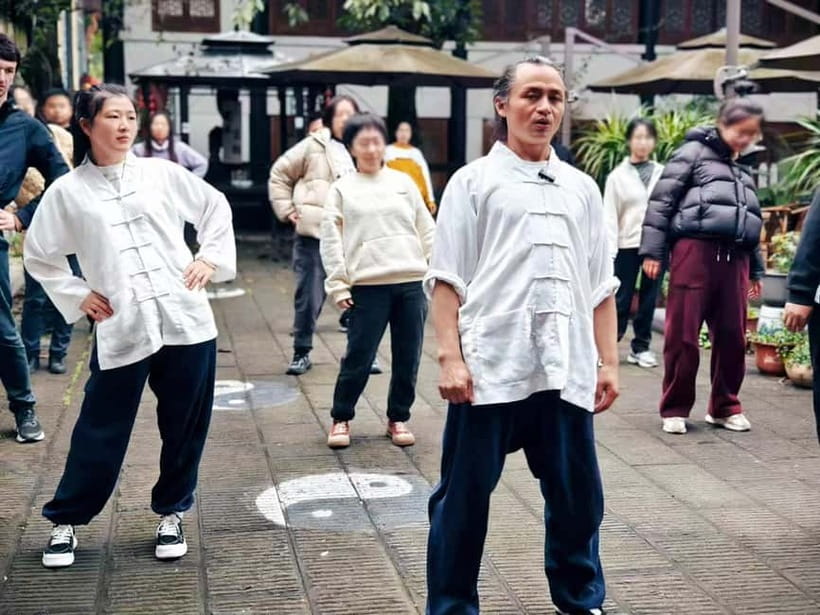
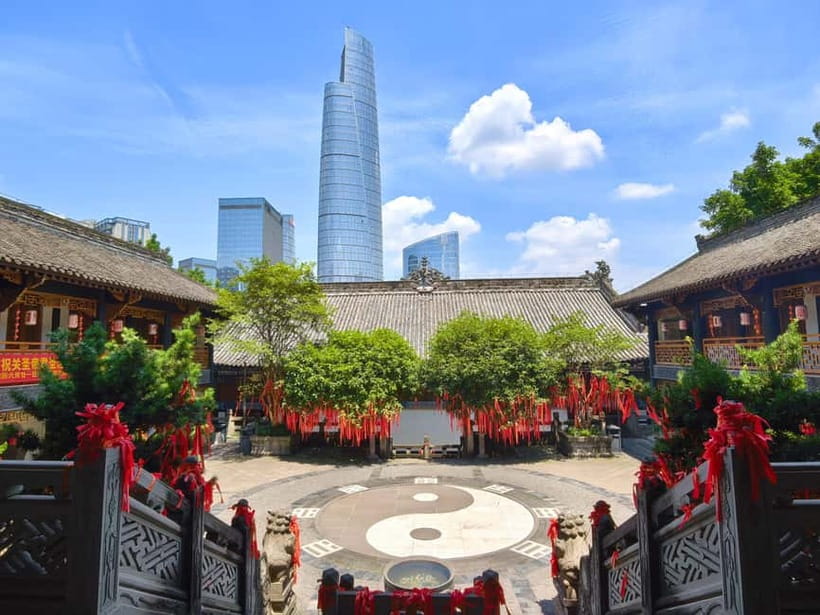
The final major activity takes place in a Taoist sanctuary within the city. Here, a national Tai Chi master and Intangible Cultural Heritage inheritor leads you through Baduanjin, an ancient wellness practice said to date back more than 800 years.
Baduanjin means Eight Silken Movements. The exercises use slow, flowing positions intended to help balance the body and settle the mind. You do not need previous experience. The movements are described as simple to learn, and the activity can suit older beginners who are comfortable standing and walking.
This is not a high-intensity workout. It is a cultural activity with a physical element, so loose, comfortable clothing is sensible. You also receive tea and small presents from the temple, giving the final stop a more personal feel.
I like this ending because it changes the pace. After transport, food, photographs, and hill walks, you finish by standing still and paying attention to movement. It gives you a direct connection to a Chinese wellness tradition rather than treating culture as something you only observe behind glass.
Two hours are allocated to the Chongqing section that includes the class and final activities. That allows time for instruction and practice instead of a rushed demonstration. Still, anyone with serious health concerns should consider the amount of walking earlier in the day, not just the gentle exercise at the end.
Transport, timing, and what you should bring
The experience lasts eight hours and returns to Yuzhong District. The route uses public transportation with Didi or a chartered car, depending on arrangements. A 15-minute ride and a 35-minute subway or metro section are listed, so you should expect the day to include regular movement between stops rather than one compact walking zone.
That transport is part of the experience. Chongqing is large and hilly, and moving between different districts helps you see how the city changes. The tradeoff is that transfer time reduces the time available at each stop.
Bring:
- Your passport
- Comfortable walking shoes
- Water
- Comfortable clothes for Baduanjin
- Insect repellent
The tour does not permit weapons or sharp objects, indoor smoking, alcohol, drugs, fireworks, explosives, littering, or nudity. Party groups, including bachelor and bachelorette groups, are not accepted. Bare feet are also not allowed.
Cancellation is flexible: you can cancel up to 24 hours before the activity for a full refund. You can also reserve now and pay later, which helps if your Chongqing schedule is still shifting.
Who will get the most from this $166 tour
This outing suits you if you want more than the standard Chongqing checklist. It is especially good for photographers, active sightseers, families, and people interested in Chinese gardens, local food, transport design, and traditional wellness.
The private format works well for families because the guide can explain things at your level and help with food choices. It can also suit solo visitors who want company without joining a large group.
You should think twice if you dislike hills, walking, public transport, or changing locations throughout the day. The itinerary includes parks, alleys, a cliffside walkway, and a wellness class. It is not suitable for wheelchair users, people with mobility impairments, people with epilepsy, or people over 80, according to the activity conditions.
The guide quality matters here because the day covers several unrelated subjects. Tian has received specific praise for patience, good English and Italian, and making the meeting point easy to find. That combination is useful in a private tour, where clear communication affects the whole day.
Should you book it?
Book this Chongqing tour if you want an active, personal introduction to the city and are happy to pay for convenience, guiding, and variety. The best parts are the unusual mix: garden design in the morning, old factories and local food at midday, Liziba’s train, mountain views, and Baduanjin to finish.
Skip it if your priority is low cost, a relaxed schedule, or a single major attraction. At $166 per person, lunch extra, it asks you to commit to a full day on your feet. For the right visitor, though, it offers a more memorable sense of Chongqing than a simple list of famous photo stops.
FAQ
How long does the Chongqing wellness and hidden sights tour last?
The tour lasts eight hours, beginning and ending in Yuzhong District.
What is included in the tour price?
The price includes a local multilingual guide, public transportation with Didi or a chartered car, a Baduanjin Qigong and Tai Chi session with a master, one cup of tea per person, small temple presents, cliffside walkway visits, a large Chinese garden, and panoramic Chongqing views.
Is lunch included?
No. Food and drinks are not included. You can arrange an authentic simple local lunch or a non-spicy-friendly hotpot option through available add-ons.
Which languages are available?
Live guiding is available in English, Traditional Chinese, French, Italian, and Spanish.
Is the tour private?
Yes. The experience is arranged as a private group tour.
How often does the Liziba monorail appear?
The train passes the viewing area approximately every four to six minutes.
Is the Baduanjin class suitable for beginners?
Yes. The movements are described as simple to learn, and no previous experience is required.
What should I bring?
Bring your passport, comfortable shoes, water, comfortable clothes, and insect repellent.
Can I cancel the tour?
You can cancel up to 24 hours in advance for a full refund. The tour also offers a reserve-now, pay-later option.
Just added in Chongqing
- Yangtze River Cruise from Chongqing to Yichang Downstream in 4 Days 3 Nights★ 4.5 · 8 reviews
- Private Day Tour to Ciqikou, Liziba, Jiefangbei etc. in Chongqing★ 4.5 · 5 reviews
- Best of Chongqing One Day Tour: Stilwell Museum, Arhat Temple, Eling Park, Panda★ 3.5 · 2 reviews
- Private Customized Tour: Chongqing City Highlights in One Day★ 5.0 · 11 reviews
- 4D3N Victoria 5-star Yangtze Cruise★ 5.0 · 3 reviews
- Private Chengdu Highlights Day Trip: Panda Base and City from Chongqing by Train★ 4.5 · 9 reviews
- Dazu Ancient Rock Carvings Private Tour Extension★ 5.0 · 24 reviews
- Chongqing private luxury city tour: Must-sees All in One★ 5.0 · 39 reviews
Massage & Relaxation, compared.
Authentic Chinese Body/Foot Massage, Hair& Head SPA
Read our review →
Shanghai Guided Royal Banquet Photo (Incl) with Massage Opt
Read our review →
Chongqing Luxury Hot Spring and Massage Luxury Meal Private Tour
Read our review →
3-Day Beijing Tour Tai Chi, Peking Duck, Hotpot and Spa
Read our review →Where else this tour turns up