
Reviewed · MUSEUMS
Chengdu: Du Fu Thatched Cottage Museum Ticket for Adult
Poetry grows well beside water. Du Fu Thatched Cottage pairs Tang Dynasty literature with bamboo, streams, courtyards, and calm garden paths in central Chengdu. I like the mix of serious cultural history and easy sightseeing, and I like that a single admission ticket gives you access to the full museum grounds rather than just one exhibit.
The main drawback is that this is a museum visit, not a guided tour with a detailed schedule or named guide. You will need a passport ID to book, and while the grounds are large, the ticket itself gives admission rather than a personal explanation of every poem and building.
In This Review
- Key points to know before you go
- Why Du Fu’s Chengdu years matter
- Entering through the five-part central axis
- The Poetry History Hall and the power of calligraphy
- The Gongbu Shrine and Sichuan’s literary circle
- The reconstructed Thatched Hut Area
- Bamboo, streams, and classical garden design
- A collection of more than 30,000 items
- How much time should you allow?
- Is the $15 admission good value?
- Who will enjoy this museum most?
- Practical booking advice for Chengdu
- Should you book Du Fu Thatched Cottage?
- FAQ
- Where is Du Fu Thatched Cottage Museum?
- How much does the adult ticket cost?
- How long is the ticket valid?
- Do I need a physical ticket?
- Can I enter through any gate?
- What identification do I need?
Key points to know before you go
- Du Fu wrote more than 240 poems here: The poet lived beside Huanhua Stream for nearly four years after fleeing the An Lushan Rebellion.
- The museum is almost 300 acres: Allow time for gardens, bamboo groves, streams, halls, shrines, and the reconstructed thatched hut.
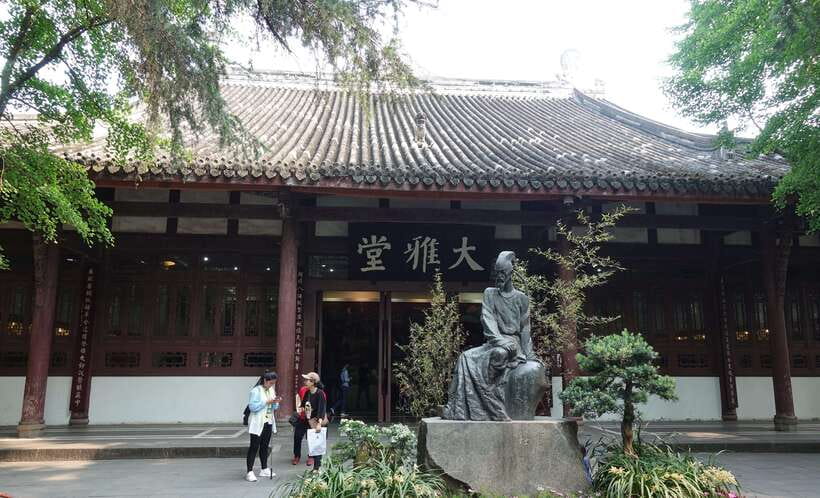
- The Poetry History Hall is the cultural center: It contains a statue of Du Fu and plaques with famous calligraphy.
- The architecture follows a central axis: You move through the Front Gate, Grand Lobby, Poetry History Hall, Chaimen Gate, and Gongbu Shrine.
- The collection holds over 30,000 items: Ancient editions, manuscripts, and translations make this more than a pretty garden.
- The $15 ticket is flexible: Entry is valid for one day, and cancellation is free up to 24 hours before the visit.
Why Du Fu’s Chengdu years matter
Du Fu arrived in Chengdu in the winter of 759 AD. He was fleeing the disorder of the An Lushan Rebellion, a period of upheaval that shook the Tang Dynasty. By the next spring, friends had helped him build a simple home beside Huanhua Stream.
That home became known as the Chengdu Thatched Cottage. Du Fu lived there for close to four years and wrote more than 240 poems during his stay. The number matters because this is not a memorial built around one famous line or one brief visit. Chengdu was a major, productive chapter in his life.
Du Fu is often called the Poet Historian because his writing records social conditions as well as personal feeling. His poems give you a view of Tang society through the eyes of someone living through political disorder, displacement, poverty, friendship, and ordinary domestic life.
You do not need to read classical Chinese poetry to appreciate the setting. The museum helps connect the physical place to the man who wrote there. The streams and trees explain why the site has such a quiet mood, while the halls and displays provide the historical frame.
I would give the historical background a little attention before arriving. Even a short introduction to Du Fu’s life will help you understand why a modest hut and a set of calligraphy plaques carry so much weight.
More Museums in Chengdu:
- Private Chengdu Day Tour: Giant Pandas and Jinsha Site Museum
★ 5.0 · 142 reviews - Sanxingdui Museum+Chengdu Panda Base or Jinsha Site Tour
★ 5.0 · 10 reviews - Sanxingdui Museum Small Group Tour with Optional Panda Base
★ 5.0 · 3 reviews
Entering through the five-part central axis
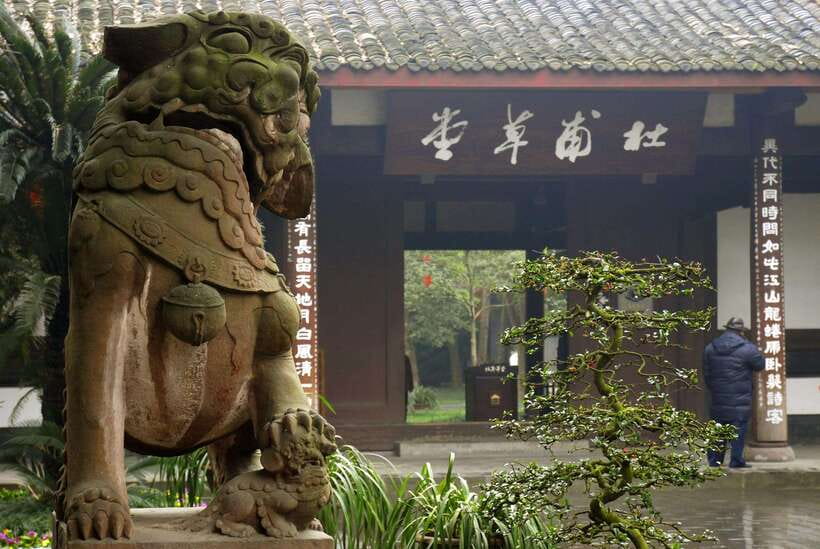
The major buildings are arranged along a central axis, a traditional layout that gives the complex a clear rhythm. You begin at the Front Gate, continue toward the Grand Lobby, and then reach the Poetry History Hall, Chaimen Gate, and Gongbu Shrine.
This sequence is useful because it turns the museum into a gradual introduction rather than a jumble of buildings. The formal entrance leads into the public and ceremonial parts of the site. As you continue, the focus shifts toward Du Fu’s writing, his memory, and the people who honored him later.
The architecture you see today preserves features from the Ming Dynasty period around 1500 and the Qing Dynasty period around 1811. These dates do not mean every structure is Du Fu’s original home. The present complex has been preserved, rebuilt, and developed over many centuries, so you should think of it as a historical memorial and museum site rather than an untouched Tang Dynasty residence.
That distinction makes the visit more honest and more interesting. You are seeing layers of Chinese architectural memory, including later efforts to protect and honor Du Fu’s legacy.
Corridors and smaller buildings flank the main route. They help frame the central spaces and make the grounds feel orderly. The design also gives you plenty of opportunities to pause, look back at a gate or roofline, and notice how the buildings relate to the gardens.
The Poetry History Hall and the power of calligraphy
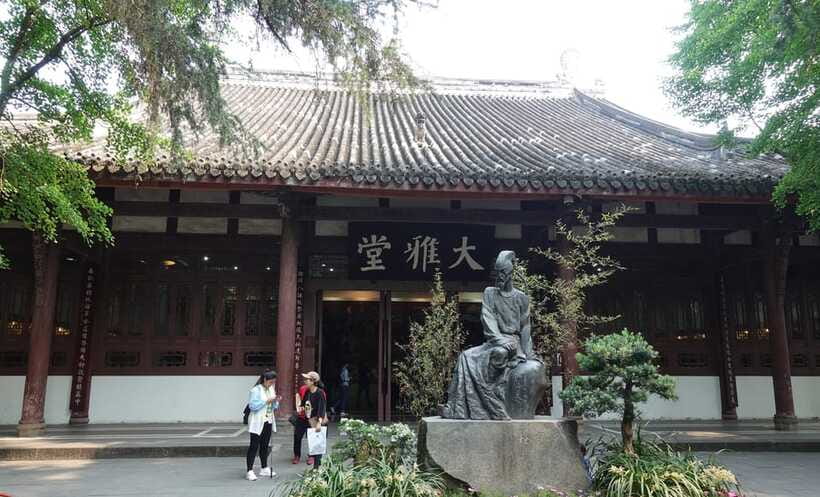
The Poetry History Hall is the main cultural stop. It contains a statue of Du Fu and plaques bearing famous calligraphy, placing the poet’s image beside the written tradition that kept his work alive.
For me, this is the part of the visit that best explains why Du Fu remains important. A statue can honor a person, but the calligraphy points you back to the poems themselves. The hall links literature, art, memory, and craftsmanship in one room.
If you cannot read the characters, do not rush past. Look at the form of the writing, the spacing, and the contrast between the formal hall and the natural setting outside. Chinese calligraphy is not only a way to transmit words. It is also a visual art, and the plaques give the poetry a physical presence.
The hall may appeal most to visitors who already know Du Fu, but it is still a useful anchor for first-time learners. You can use it as a pause between the garden sections. Read whatever translations or explanations are available, then step outside and consider the kind of quiet setting that surrounded the poet.
The museum was established in 1955 as the Du Fu Memorial Museum and received its current name in 1985. It was designated a National Key Cultural Relic Protection Unit in 1961. Those institutional details help explain the care given to the site and its importance within China’s cultural preservation system.
The Gongbu Shrine and Sichuan’s literary circle
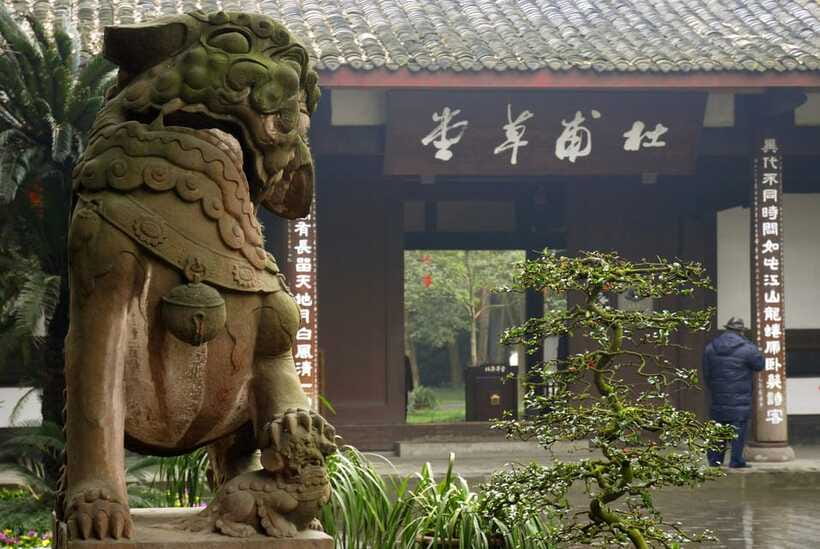
The Gongbu Shrine honors Du Fu along with Huang Tingjian and Lu You, two other poets who lived in Sichuan. The shared setting broadens the story beyond one writer.
This is a useful stop if you want to understand how literary reputations build over time. Du Fu’s life belongs to the Tang Dynasty, while Huang Tingjian and Lu You represent later periods. Bringing them together shows how Sichuan became connected to several major figures in Chinese poetry.
The shrine also gives the visit a more ceremonial feel. The Poetry History Hall focuses on Du Fu and his work. The Gongbu Shrine places him within a longer line of poets who found a home, subject matter, or creative energy in Sichuan.
I would not expect a full literary lecture from the admission ticket. The value here comes from the setting, the names, and the chance to connect different eras. If poetry is your main reason for visiting, take note of any plaques or explanatory material and allow extra time to read carefully.
A few more to weigh up in Chengdu
- Chengdu: Giant Panda Breeding Research Base Ticket
★ 4.5 · 580 reviews - Half-Day Chengdu Cooking Class with a Local Market Visit
★ 5.0 · 465 reviews - Tuktuk Food Tour Through Chengdu’s Local Eats
★ 5.0 · 435 reviews - Private Half-Day Chengdu Panda Breeding Center Tour with Optional Volunteer
★ 5.0 · 353 reviews
The reconstructed Thatched Hut Area
The Thatched Hut Area recreates Du Fu’s rustic dwelling. It is not the original hut from 759 AD, but it gives you a clear visual idea of the simple home associated with his Chengdu years.
This is one of the most approachable parts of the museum. You do not need specialist knowledge to understand the contrast between the formal halls and the small, plain dwelling. The hut brings the story down to human scale.
The reconstruction also helps you picture the setting described in accounts of Du Fu’s life here. He was not living in a grand palace. He was writing beside a stream in a modest home, supported in part by friends after a period of war and displacement.
That context changes how you read the poems. The museum is not only presenting a famous author as a distant cultural figure. It is showing a person trying to create a stable home and continue his work during an unsettled time.
Take a moment to compare the hut with the later architecture around it. The contrast is deliberate and useful. One shows the poet’s daily life as remembered and reconstructed. The others show how later generations shaped a place to preserve that memory.
Bamboo, streams, and classical garden design
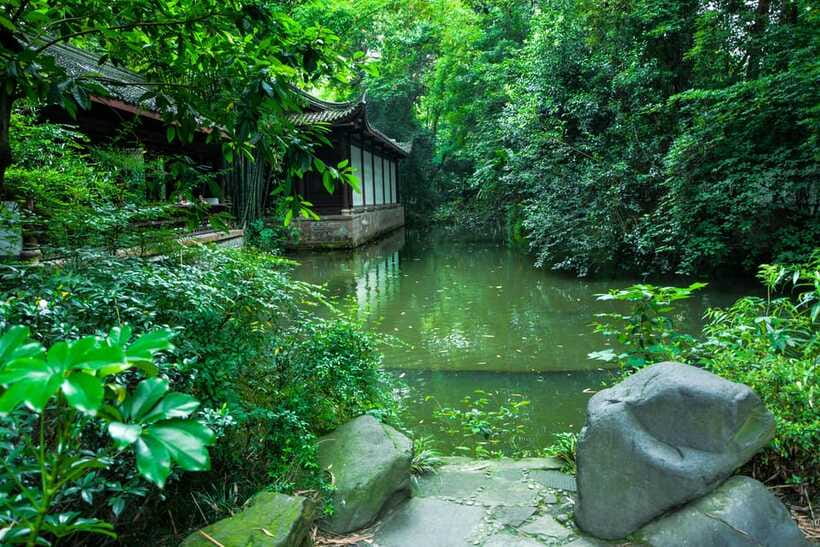
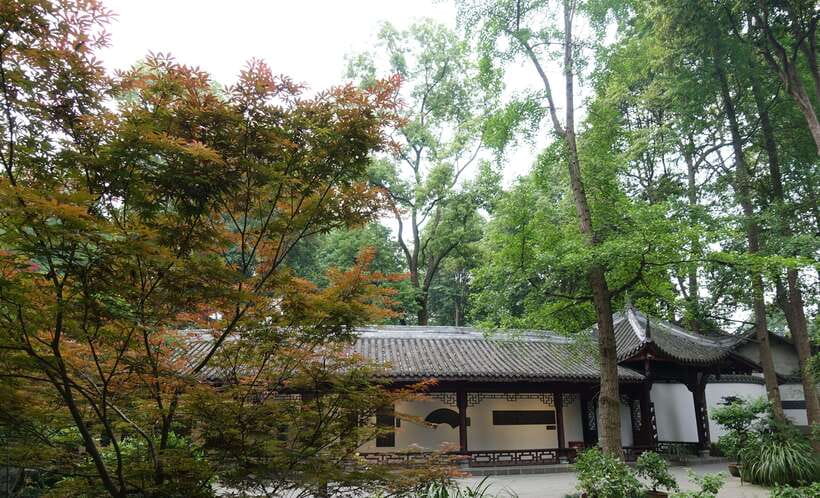
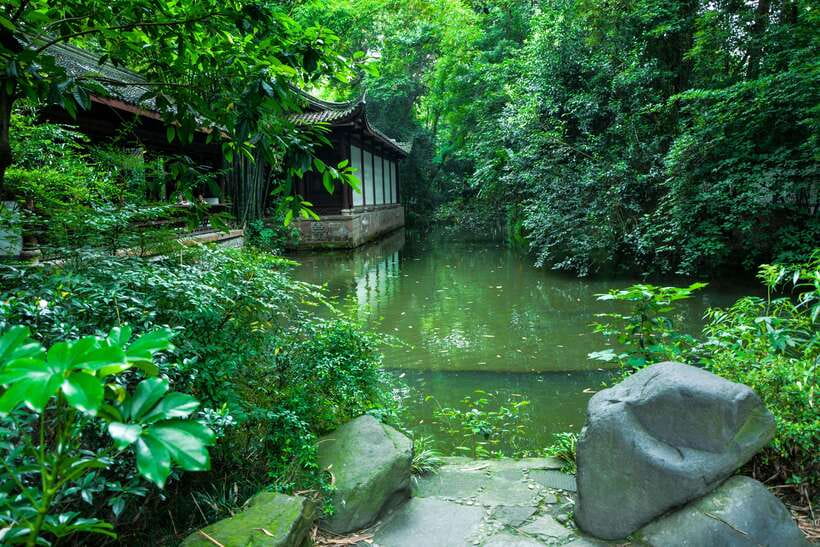
The grounds cover nearly 300 acres, so the garden is not a small decorative patch between buildings. You will find bamboo groves, flowing streams, trees, paths, and classical Chinese architectural details spread across a broad area.
I like this part of the experience because the garden is not separate from the museum’s subject. Huanhua Stream was part of the story of Du Fu’s home, and water remains one of the site’s defining features. The setting gives you a better sense of why the cottage became associated with quiet reflection and poetic work.
The garden also provides a welcome change of pace after the halls. You can move from artifacts and calligraphy to shaded paths and open views. That makes the museum suitable for people with different interests in the same group. One person can focus on poetry while another enjoys the buildings and plants.
The grounds may also make the visit feel longer than the ticket suggests. Admission is valid for one day, and you should use that flexibility rather than trying to race through every structure. The listed visiting hours are 09:00 to 18:00, so plan your arrival with enough time to see both the main axis and the garden areas.
Because the site is large, comfortable walking shoes are a sensible choice, even though they are not listed as a formal requirement. That is practical advice based on the size of the grounds, not a claim about a specific route or surface.
A collection of more than 30,000 items
Du Fu Thatched Cottage Museum holds over 30,000 items. The collection includes ancient editions, manuscripts, and translations of Du Fu’s works.
This changes the character of the site. You are not simply visiting a scenic memorial with a replica hut. The museum also functions as a serious resource for studying Du Fu’s life and poetry.
Ancient editions can show how his writing was copied, preserved, and passed through later generations. Manuscripts bring attention to the physical process of writing and transmission. Translations help make the collection more useful to people who cannot read classical Chinese.
The exact displays available during your visit can vary, so I would avoid planning the entire day around one particular manuscript or edition. Think of the collection as the museum’s scholarly backbone. The garden may be the most immediately appealing part, but the holdings explain why the site carries national cultural importance.
If you enjoy museums, spend real time with the displays rather than treating them as a quick stop between photo opportunities. If you are mainly interested in architecture and gardens, you can still make the collection a short but meaningful part of your route.
How much time should you allow?
The ticket is described as valid for one day, with entry available from 09:00 to 18:00. The experience does not provide a fixed itinerary with timed stops, so you control the pace.
I would allow several hours if you want to see the central buildings, Thatched Hut Area, garden paths, and collection displays without rushing. A shorter visit can cover the main axis and the reconstructed hut, but the large grounds reward a slower approach.
The listed group type is small, limited to 10 participants. Since the product is an admission ticket rather than a stated guided walk, do not assume that a guide will lead you through the museum. The small-group note may matter for the booking arrangement, but the practical experience is still largely your own museum visit unless other instructions are provided at booking.
Entry is available at all main gates. You do not need a physical ticket. You use your passport ID or an electronic voucher for direct verification, and you should bring the same passport connected to the booking.
The passport rule is especially important. A passport ID is needed to book, and the instructions specifically require a passport. Check that your booking details match your identification before setting out.
Is the $15 admission good value?
At $15 per adult, the ticket offers solid value if you care about Chinese poetry, historic architecture, or garden design. You receive access to a nearly 300-acre museum site with major halls, a shrine, a reconstructed home, scenic grounds, and a collection of more than 30,000 items.
The value is less obvious if you want a guided literary lesson. The information provided covers admission, not a private guide, transport, food, or a set sequence of talks. You may need to do some preparation or read the displays carefully to get the most from the visit.
I would compare it with the cost of a simple city attraction rather than with a full-day guided excursion. The ticket gives you room to set your own pace and stay as long as the opening hours allow. That flexibility is useful in Chengdu, especially if you want a quiet cultural stop that does not force you into a tight schedule.
Free cancellation up to 24 hours before the visit and reserve now, pay later terms add practical value. They do not change the museum itself, but they make the booking easier to fit around a changing China itinerary.
Who will enjoy this museum most?
I would recommend Du Fu Thatched Cottage to you if you enjoy literary landmarks, traditional Chinese architecture, museum collections, or peaceful gardens. It is also a good choice if you want a cultural stop with more substance than a photo location.
Families may appreciate the reconstructed hut and open garden setting, though the poetry displays will be most rewarding for older children and adults who can engage with the historical material. Students of Chinese literature will find the museum especially relevant because of Du Fu’s large body of work and the size of the collection.
You may want to lower your expectations if you need every exhibit explained in English or prefer a guided activity with a clear timetable. The supplied information does not promise a guide, language service, or audio tour, so prepare to explore independently.
I also like this site for a second visit to Chengdu. It gives the city a quieter cultural side, away from the pressure to fill every hour with famous food, shopping, and major sights.
Practical booking advice for Chengdu
Book with your passport ID, and bring your passport on the day. No physical ticket is required, so your admission is verified through your ID or electronic voucher at one of the main gates.
The museum is at 37 Qinghua Road in Chengdu’s Qingyang District. Opening hours for use are 09:00 to 18:00. Because the grounds are broad, arriving earlier in the day gives you more breathing room, though the available information does not identify a less crowded period.
The ticket is for adults at $15 per person. Confirm the available date and starting information when booking, since the product is valid for one day rather than an open-ended pass.
If your plans change, cancel at least 24 hours in advance for a full refund. You can also reserve and pay later, which is helpful when other parts of your Chengdu schedule are still moving.
Should you book Du Fu Thatched Cottage?
Book it if you want a calm, substantial cultural experience built around one of China’s most important poets. The strongest reasons are the connection to Du Fu’s nearly four years in Chengdu, the Poetry History Hall, the reconstructed hut, the classical gardens, and the museum’s large collection.
Skip it if you are looking for a guided tour, transport, or a tightly scripted activity. The ticket gives you access, not a personal interpreter. With a little reading before you arrive, though, the site becomes much more than a pleasant garden walk. At $15, it is a good-value choice for an independent visit with real historical and literary weight.
FAQ
Where is Du Fu Thatched Cottage Museum?
It is located at 37 Qinghua Road in Chengdu’s Qingyang District, in southwestern China.
How much does the adult ticket cost?
The adult ticket costs $15 per person.
How long is the ticket valid?
The ticket is valid for one day. The stated usage hours are 09:00 to 18:00.
Do I need a physical ticket?
No. You can use your passport or electronic voucher for direct verification at the museum.
Can I enter through any gate?
Entry is available at all main gates of Du Fu Thatched Cottage Museum.
What identification do I need?
You need a passport to book, and you should bring your passport for entry verification.
Just added in Chengdu
- Visiting Chengdu Panda Base in a Half Day★ 5.0 · 4 reviews
- Classsic sichuan Opera at sichuan Provincial Theater★ 5.0 · 4 reviews
- Tea Village in lost Town and Buddha 1 day tour★ 5.0 · 32 reviews
- Panda, Leshan, and Emei Mountain 2-day tour★ 5.0 · 4 reviews
- Sichuan Opera with face-changing at Sichuan opera theater★ 4.5 · 6 reviews
- Sichuan Opera Show with Hotel Pickup★ 5.0 · 3 reviews
- Mini Group: Half-Day Chengdu Pandas Guided Tour★ 5.0 · 3 reviews
- Sanxingdui Ruins and Giant Pandas Private Day Tour from Chengdu★ 5.0 · 5 reviews
Museums, compared.
Tianmen Square, Forbidden City & Royal Museum Tours
Read our review →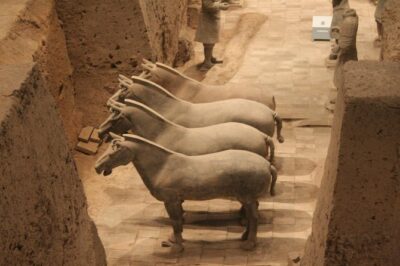
Half-Day Mini Group Xian Tour to Terracotta Warriors Museum
Read our review →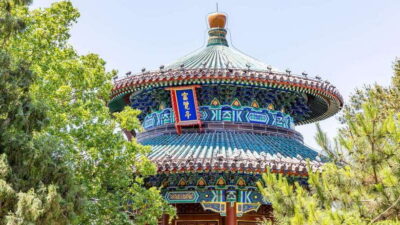
Beijing:Jingshan Park (Palace Museum Garden) Ticket
Read our review →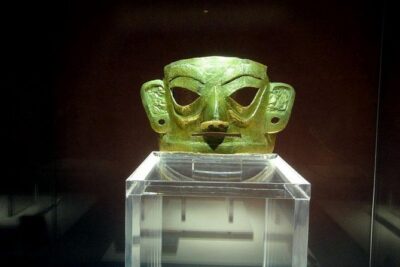
Private Chengdu Day Tour: Giant Pandas and Jinsha Site Museum
Read our review →
Private Xi’an Tour: Terracotta Warriors, Hanyangling Museum, Cave Homes
Read our review →
Beijing Half Day: National Museum of China In-depth Tour with Subway Transfer
Read our review →
Terracotta Warriors Museum Ticket with Professional English-speaking tour guide
Read our review →Where else this tour turns up