Reviewed · SHANGHAI TOURS
Red Route Tour- Chinese Communist Party
China’s modern story begins in surprising places. This three-hour private tour links Shanghai’s polished Xintiandi district with the former French Concession and the Shanghai Propaganda Poster Art Centre, giving you a focused look at the Chinese Communist Party’s rise and public message. What I like most is the historian guide and the way the route connects real places with political history. I also like the private format, which gives your group room to ask questions.
The main consideration is cost. At $85 per person, this is not a cheap sightseeing stroll, and you will still need to pay for transportation between sights and admission fees. The tour is best for you if modern Chinese politics interests you, but it may feel too narrow if you want a broad introduction to Shanghai.
In This Review
- Key points to know before booking
- Why this short Shanghai history tour works
- Starting in Xintiandi, where modern Shanghai meets party history
- The First National Congress site and the story behind it
- From Xintiandi to the Propaganda Poster Art Centre
- Why the poster collection is the tour’s visual highlight
- XinTianDi BeiLi and the city around the monuments
- The guide can make or break a political history tour
- Is $85 per person a fair price?
- Who should book this experience?
- Practical planning for the three-hour route
- My verdict: a strong choice for the right interest
- FAQ
- How long does the Red Route Tour last?
- Is hotel pickup included?
- Is this a private tour?
- What places are included on the route?
- Is transportation between the attractions included?
- Can I cancel for a full refund?
Key points to know before booking
- The tour starts at the Communist Party’s birthplace: You visit the site of the First National Congress in Xintiandi.
- A private historian leads the way: Only your group takes part, making discussion easier than on a large coach tour.
- The Propaganda Poster Art Centre adds visual power: Its collection includes material from the Cultural Revolution.
- Hotel pickup is included: Pickup is offered from a centrally located Shanghai hotel.
- You move through present-day Shanghai: The route passes from fashionable Xintiandi to neighborhoods tied to China’s political past.
- Plan for extra costs: Food, drinks, transportation between attractions, admission tickets, and hotel drop-off are not included.
Why this short Shanghai history tour works
Shanghai can feel like several cities layered on top of one another. Glass towers and designer shops sit close to old lanes, former foreign concessions, and sites tied to the founding of modern China. This tour uses that contrast well.
You begin with a guide at your centrally located hotel, then head to Xintiandi. From there, the route shifts from the polished commercial district to the site where the Chinese Communist Party held its First National Congress. That change of setting gives the history a useful physical anchor. You are not only hearing about political change in a classroom. You are seeing the place associated with the party’s early formation.
The tour then continues by subway or taxi to the Shanghai Propaganda Poster Art Centre. The transportation itself is not included, so you should be ready to cover that cost. Still, using public transport or a taxi keeps the outing tied to the city around you rather than placing you inside a tour bus for the entire morning.
I see the tour as a compact history lesson with Shanghai as its backdrop. In three hours, you will not cover every stage of Chinese history. You will, however, get a clear introduction to the party’s origins, its political message, and the way modern history has been presented to the public.
A few more to weigh up in Shanghai
- Authentic Local Food Tour in Central Shanghai
★ 5.0 · 1,382 reviews - Zhujiajiao Water Town and Shanghai City Private Day Tour
★ 5.0 · 1,016 reviews - Private Shanghai Full Day City Tour with Old and New Highlights
★ 5.0 · 995 reviews
Starting in Xintiandi, where modern Shanghai meets party history
Xintiandi is an unusual place to begin. Today, it is known for restaurants, boutiques, and carefully restored historic buildings. The tour asks you to walk past this polished setting toward the site connected with the First National Congress of the Chinese Communist Party.
That contrast is one of the route’s best features. You see a fashionable part of Shanghai first, then encounter a site tied to a major political turning point. The short walk helps you notice how quickly the city’s present-day commercial identity gives way to its 20th-century past.
Your guide introduces the location and explains why it matters. The party’s First National Congress was held here in 1921, and the site is treated as the cradle of the organization that later came to control China. The tour data describes admission to the Xintiandi and birthplace stops as free, but the general booking information says admission tickets are not included. I would confirm current entry arrangements before you go, especially if access rules have changed.
Do not expect a large open-air monument. The value here is the setting and the explanation. Without context, the buildings and streets can be easy to pass without a second glance. With a historian beside you, the stop becomes a starting point for discussing the party’s formation and the political pressures of the period.
The First National Congress site and the story behind it
The birthplace stop is the intellectual center of the outing. This is where you begin to understand why the Chinese Communist Party matters so much in China’s political system today.
A good guide can help you place the founding meeting within the larger story of modern China. The supplied descriptions emphasize commentary on key moments in Chinese history, including the role foreign colonial powers played in shaping the country. One particularly positive account describes the guide, Penny, as offering a concise and lively timeline that connected China’s political development with the marks left by colonial powers.
That is important because the Communist Party did not emerge in a vacuum. A visit focused only on party milestones could feel like a list of dates and leaders. The better approach is to connect the party’s rise with the instability, foreign influence, and national pressures that shaped early 20th-century China. Penny’s ability to explain those links was praised repeatedly, and that kind of guidance is likely to make the stop much more useful than a self-guided visit.
The tour is also a good fit for people who want to ask direct questions. Because this is a private activity, you are not sharing the guide with a large group. That does not guarantee every question will be answered in the same way, but it gives you more freedom to pause, ask for clarification, or spend longer on a topic that interests you.
From Xintiandi to the Propaganda Poster Art Centre
The route then moves to the Shanghai Propaganda Poster Art Centre by subway or taxi. This transfer is practical rather than scenic, and you should budget time and money for it. Transportation between attractions is specifically not included, even though hotel pickup is.
That distinction matters. The tour begins conveniently, but it is not a fully chauffeured experience. You are responsible for getting from one major stop to the next and for returning to your own hotel after the tour. The route is near public transportation, and comfortable walking shoes are recommended.
The move across Shanghai also gives you a chance to see the city in ordinary motion. You are not simply being delivered from one museum entrance to another. The connection between the sites is part of the experience, even if it requires a little planning.
Since the tour lasts about three hours, the schedule is fairly tight. Allow extra time if you are prone to lingering over exhibits or asking long questions. If you want a relaxed museum visit with plenty of time for every display, this may feel compressed. If you want a strong introduction before exploring further on your own, the pace should suit you.
A completely different sort of day out:
- Shanghai: Hop-on Hop-off Bus Ticket and Optional Attractions
★ 3.4 · 692 reviews - Shanghai Private Tour: Zhujiajiao Water Town and Boat Ride
★ 5.0 · 661 reviews - Eat Like A Local: Shanghai Night Food Tour
★ 5.0 · 616 reviews - Huangpu Night Cruise: Cozy Vibe & Modern Shanghai Glow
★ 4.3 · 520 reviews
Why the poster collection is the tour’s visual highlight
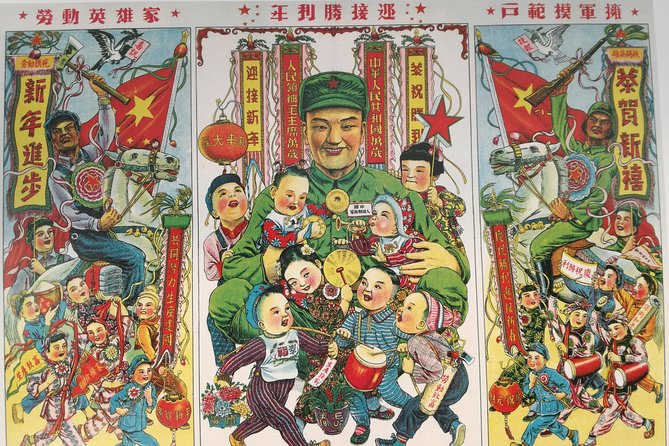
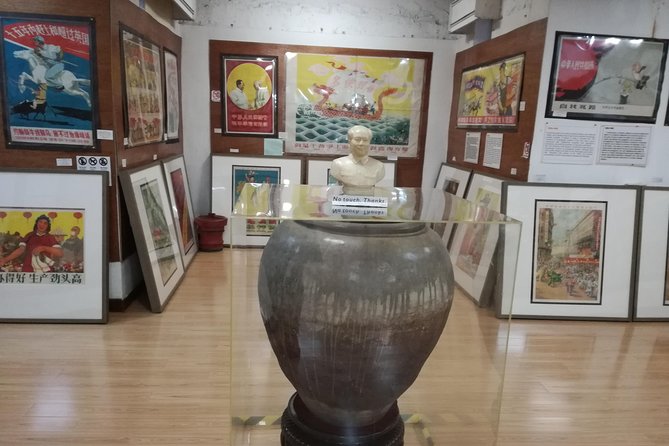
The Shanghai Propaganda Poster Art Centre gives the history a visual edge. Its collection includes posters and related material from the Cultural Revolution, a period when public art and political messaging were closely linked.
This is where you see how official ideals were turned into images. Posters were designed to communicate quickly and widely, often presenting workers, soldiers, farmers, political leaders, and national goals in bold, direct forms. Even if you know little about Chinese political history, the artwork gives you a way into the subject.
The collection has been described as extensive, with a remarkable range of propaganda posters. That makes the stop more than a quick museum visit. It shows how the party presented its values, celebrated particular political moments, and shaped public life through images.
At the same time, you should keep the museum’s point of view in mind. One careful assessment of the tour described the material as official history, while still finding the museum worthwhile because of the amount and quality of its poster collection. That is a fair way to approach the visit. The displays can tell you a great deal about political communication and public memory, but you should not treat one institution’s presentation as the only possible interpretation of China’s past.
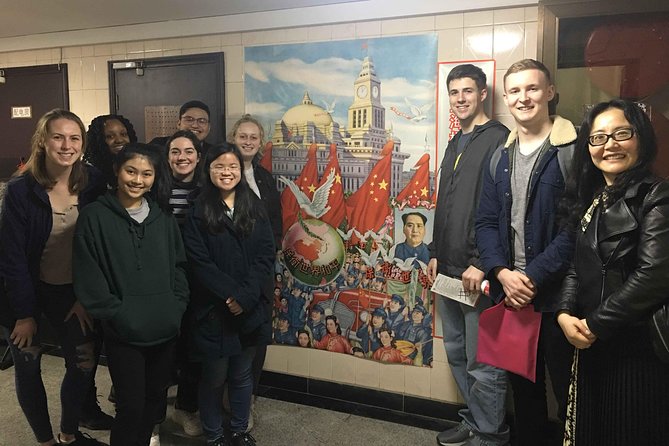
Your guide’s role is especially useful here. Penny was praised for providing clear explanations and placing the exhibits along a wider Chinese historical timeline. Ask questions about what the posters show, who they were made for, and what they leave out. The museum is most valuable when you look at both the artwork and the message behind it.
XinTianDi BeiLi and the city around the monuments
XinTianDi BeiLi is included as another point in the Xintiandi area. The supplied details do not give a separate description of what you will see there, so I would think of it as part of the district’s broader setting rather than a completely different attraction.
Its usefulness comes from the surrounding streets. You can see how a politically important historic area has been incorporated into a modern entertainment and shopping zone. Restaurants and boutiques now share space with places connected to the party’s early history. That layering is very Shanghai: the past is not always separated from daily life by a formal museum boundary.
This part of the route may appeal to you if you enjoy observing how cities reuse old neighborhoods. It may disappoint you if you expect every stop to offer a major monument or a long museum visit. The tour’s strength is the connection among the stops, not the size of any single site.
The guide can make or break a political history tour
The guide is central here. The tour is sold with a professional historian guide, and the strongest praise has focused on Penny. Descriptions of her guiding highlight clear explanations, a lively timeline, attentiveness, and useful suggestions for restaurants and shopping after the tour.
That last detail is small but practical. If you are new to Shanghai, a guide who can help with the rest of your day adds value beyond the formal route. The advice is not the main reason to book, but it can help you use your time in the city more wisely.
The tour also appears well suited to different levels of prior knowledge. A history professor found the guide well informed, while other participants valued the simple, concise explanation of China’s modern past. That suggests the experience can work for both serious students and curious first-time visitors, provided you tell your guide what you already know.
I would not book this expecting a neutral academic seminar with every interpretation represented. Political history in China requires care, and the tour is centered on Communist Party landmarks and official materials. I would book it expecting a guided introduction that gives you places, dates, images, and context to think about afterward.
Is $85 per person a fair price?
The price is $85 per person, which is a meaningful expense for a three-hour activity. The private format and historian guide are the main reasons the price can make sense. You are paying for a focused route and personal explanation, not simply entry to a museum.
The value is strongest if you are traveling with a small group that wants the same subject. A private tour lets you shape the conversation and avoids the stop-and-start rhythm of a large group. It can also save you the work of researching the birthplace site and poster museum on your own.
The value is weaker if you mainly want to see Xintiandi or browse the museum without much explanation. You will also need to pay for transportation between attractions, food and drinks, and any admission fees. Hotel pickup is included, but hotel drop-off is not, so include that in your day’s plan.
I would compare this price with what you would spend arranging a private guide independently. The tour is not a bargain in the simple sense, but it may be fair for a history-focused private outing with hotel pickup and a specialist guide.
Who should book this experience?
I recommend it most strongly for:
- You have a real interest in Chinese political history.
- You want to understand the Communist Party’s origins and continuing influence.
- You prefer a private guide to a large sightseeing group.
- You enjoy museums, political art, and historical interpretation.
- You want to connect Shanghai’s neighborhoods with major events.
- You have only half a day for a focused subject.
It is less suitable if you want a broad first tour of Shanghai’s main sights. The route does not focus on the Bund, Shanghai Tower, classical gardens, or general city orientation. It also may not suit young children unless they already have an interest in history, since the subject is serious and the schedule centers on political sites and museum material.
Children must be accompanied by an adult, and most people can participate. Comfortable shoes are sensible because the tour includes walking through Xintiandi and movement between sites.
Practical planning for the three-hour route
The tour lasts about three hours, so I would keep the rest of your schedule flexible. Pickup is offered from a centrally located hotel, but you should provide accurate hotel details when booking and confirm that your location qualifies.
The experience is usually booked well ahead, with an average booking time of about 34 days before the visit. That does not mean you must reserve that early, but it is a useful signal if your dates are fixed. Confirmation is normally sent at booking. If you book within five days of the tour, confirmation may take up to 48 hours and depends on availability.
Bring comfortable walking shoes and be prepared for subway or taxi travel. Since transportation to the attractions is not included, carry a practical payment method for those costs. Food and drinks are also your responsibility, so plan a snack or meal before or after the tour rather than expecting one during it.
Free cancellation is available if you cancel at least 24 hours before the local start time. Changes or cancellations inside that window are not accepted for a refund.
My verdict: a strong choice for the right interest
I would book the Red Route Tour if I wanted a clear, compact introduction to the Communist Party’s history in Shanghai. The First National Congress site gives the subject a real location, while the Propaganda Poster Art Centre shows how political ideals were turned into public images. The private format and guide Penny’s praised ability to explain complex material add real value.
I would skip it if my main goal were general sightseeing or if I disliked museum-based political history. At $85, plus transport and possible admission costs, the tour needs to match your interests. For the right visitor, though, it offers a thoughtful way to see Shanghai beyond its skyline, shopping streets, and famous waterfront.
FAQ
How long does the Red Route Tour last?
The tour lasts approximately three hours.
Is hotel pickup included?
Yes. Pickup is included from your centrally located Shanghai hotel. Hotel drop-off is not included.
Is this a private tour?
Yes. Only your group participates in the activity.
What places are included on the route?
The route includes Xintiandi, the birthplace of the Chinese Communist Party and First National Congress site, the Shanghai Propaganda Poster Art Centre, and XinTianDi BeiLi.
Is transportation between the attractions included?
No. Transportation to and from the attractions is not included. The route may use the subway or a taxi.
Can I cancel for a full refund?
Yes, if you cancel at least 24 hours before the experience’s local start time. Cancellations or changes made less than 24 hours before the start are not refunded or accepted.
Just added in Shanghai
- Zhujiajiao Water Village: Private Tour from Shanghai★ 4.9 · 43 reviews
- Zhujiajiao with Private Customized Shanghai City Highlights★ 5.0 · 14 reviews
- Zhujiajiao & Shanghai:Private Day Tour Water Town to Skyline★ 5.0 · 12 reviews
- Zhujiajiao Water Town Private Tour with Night River Cruise★ 5.0 · 9 reviews
- Zhujiajiao & Shanghai:Small Group Tour Water Town to Skyline★ 5.0 · 4 reviews
- Yu Garden Shanghai Entry Tickets Booking And Trip★ 3.6 · 9 reviews
- Water Town Zhujiajiao Shanghai: Boat Ride,Sights,Bites&Sips★ 5.0 · 7 reviews
- shanghai Disney tour★ 5.0 · 12 reviews
Shanghai Tours, compared.

Authentic Local Food Tour in Central Shanghai
Read our review →
Zhujiajiao Water Town and Shanghai City Private Day Tour
Read our review →
Private Shanghai Full Day City Tour with Old and New Highlights
Read our review →
Hop-on Hop-off Bus Ticket and Optional Attractions
Read our review →
Shanghai Private Tour: Zhujiajiao Water Town and Boat Ride
Read our review →
Huangpu Night Cruise: Cozy Vibe & Modern Shanghai Glow
Read our review →